
Roll Labels vs Sheet Labels vs Die-Cut Stickers:
Which Format Costs Less for Your Order?
When we purchase custom-printed labels and stickers, we usually focus on price. But hidden costs from format, production process, order volume and usage often get overlooked. Roll labels, sheet labels and die-cut stickers do not simply differ in upfront price.
The choice of label format affects per-unit cost, labeling speed, storage requirements, minimum order quantity, and labor needed for packaging.
A business labeling 50 products will have very different needs to that of a manufacturer labeling 5,000 products.The lowest price quote may not be the best value when you factor in the cost of your time, the amount of material waste and the amount of space the product will take up in storage.
This guide breaks down the real-world differences between roll labels, sheet labels and die-cut stickers. It also shows which format generally delivers better cost-efficiency for different orders.
Quick Comparison: Roll Labels vs. Sheet Labels vs. Die-Cut Stickers
Before diving into the detailed cost structures, here is how the three formats compare at a glance:
| Feature / Factor | Roll Labels | Sheet Labels | Die-Cut Stickers |
|---|---|---|---|
| Best Order Volume | Medium to High; usually 1,000+ units | Low to Medium; often 50–500 units | Low to Medium; often 100–2,000 units |
| Setup / Press Cost | Moderate to High for some processes | Low to None for digital printing | Low to Moderate |
| Unit Price at High Volume | Usually Lowest | Moderate | Usually Highest |
| Unit Price at Low Volume | Moderate to High | Often Lowest | Moderate |
| Application Method | Hand application or machine dispenser | Manual application | Mostly manual application |
| Primary Use Case | Product packaging and production lines | Small runs, SKU testing, office use | Promotional giveaways, samples and standalone merchandise |
These cost and quantity ranges are general guidelines. Actual pricing depends on material, label size, printing method, finishing, adhesive, order quantity, and application requirements.
Roll Labels: Best for high‑volume production and automatic labeling
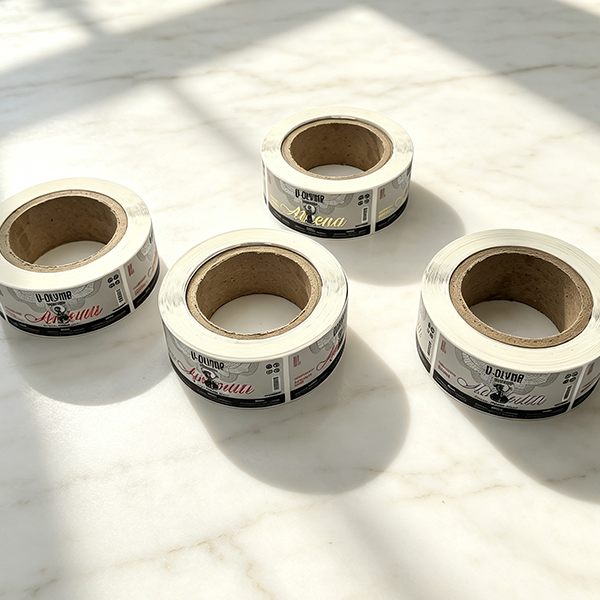
Roll labels are printed labels wound continuously around a core(typically 1″ or 3″ in diameter, If you are unsure how to pick the right core size, feel free to read this article —How to Choose the Label Roll Core Size for Your Printer) to form neat rolls. They work for both hand application and high‑speed labeling with automatic label dispensers.
Direct Costs:
These labels have low costs for large orders. Continuous production runs are efficient with very little material waste. Setup and die charges get spread across many units, creating a strong per‑unit price advantage. On the other hand, costs jump sharply for small orders. Fixed setup fees and die charges still apply. When these one‑time costs are divided over only a small number of labels, the per‑unit price becomes high.
Hidden costs:
Roll labels work with high-speed automatic machines. They cut labor during product packaging. For repeated packaging work, they reduce processing time. They also keep label placement consistent and avoid extra work.Additionally, the compact roll structure maximizes space efficiency by minimizing the gaps between labels, resulting in a smaller footprint.
Sheet Labels: Ideal for Small Batches & Multi-SKU Testing
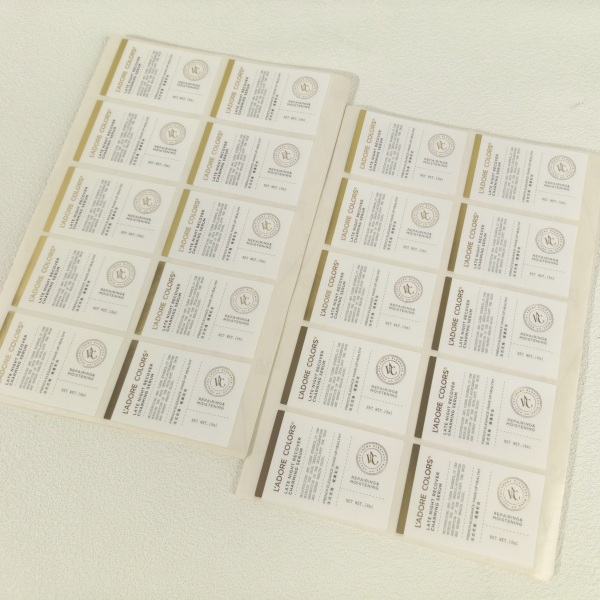
Sheet labels are multiple stickers printed onto standard flat sheet backing paper. Each sticker on the backing sheet stands alone and can be torn off by hand.
Direct Costs:
Unlike roll labels, sheet labels become more expensive at high production volumes. Printing runs slower, and some edge waste is unavoidable. They cost less for small-quantity orders. No custom die is needed, which is their main benefit. You can use digital printing or office printers. They offer great flexibility with no strict minimum order requirement. They work well for samples or short-term promotions.
Hidden costs:
Sheet labels rely entirely on manual application, which dramatically escalates labor expenses on larger runs.Compared to automatic labeling for roll labels, manual work adds time and labor costs. When stacked, gaps form between individual sheets and within the stack. This creates a larger overall size. Sheet labels use storage space less efficiently than roll labels, which leads to extra storage and shipping fees.
Die-Cut Stickers: Built for Promotional Branding & Standalone Merch
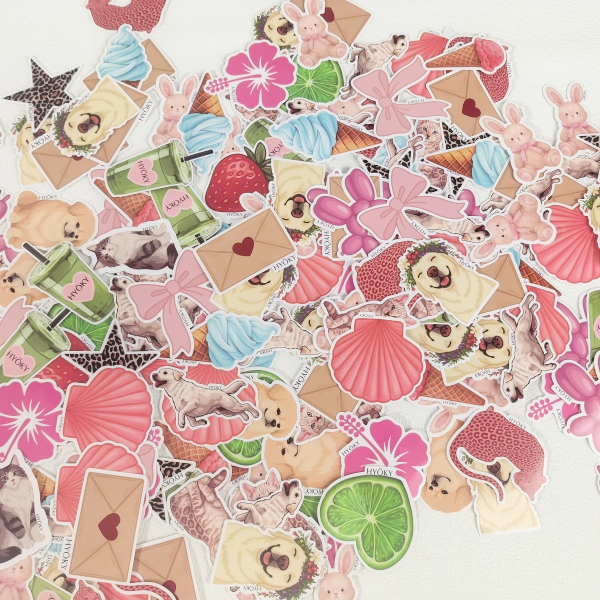
Die‑cut stickers follow your design to cut through both the top sticker material and the backing liner along the exact outline. Each sticker works on its own. You just peel off the release liner on the back before application.
Direct Costs:
Die-cut stickers are very cost efficient for small runs and for market testing. Digital laser cutting of stickers allows for production of complex shapes without the need for expensive custom physical dies or complex set-up for individual stickers as opposed to roll labels. However, unit costs scale up significantly for large-volume orders. High-volume production requires custom steel dies for complex shapes, and the post-processing step of cutting stickers into individual standalone units adds extra labor and machine fees.
Hidden costs:
Die-cut stickers are similar to sheet labels and also not suitable for automatic labeling machines. Stickers have to be peeled from the sheet one by one and then applied manually. The manual application of individual labels is also very time consuming and prone to errors which can result in wasted materials and costly rework. Poor use of space also results in additional storage requirements and higher cost of shipping.
Which Should You Choose: Roll Labels, Sheet Labels, or Die-Cut Stickers?
After reviewing the cost breakdown for roll labels, sheet labels and die‑cut stickers, you should now have a basic understanding of these three options. When should you use each format?
Roll Labels:
If you use an automated production line for labeling and have large‑volume label requirements, roll labels are your first choice.These are best for rapid and continuous labeling of products on production lines for food & beverage, personal care & cosmetics,health care and industrial electronics manufacturers. They support on‑demand printing and instant labeling for e‑commerce logistics, fresh retail, and warehouse management. Whether for factory mass production or downstream product handling, roll labels keep labeling work fast and consistent.
Sheet Labels:
Sheet labels are not suited for high‑volume assembly‑line production. With strong flexibility and easy handling, they work well for small‑batch runs, custom jobs, new‑product sample builds, and hand labeling.
They fit solo operators, small businesses, and new startup brands. Common uses include gift stickers, handmade‑item labels, and office file labels. Especially for pre‑launch sample testing, short‑term promotions, or trial phases with limited budget, sheet labels let you skip high setup and die charges. They are flexible and cost‑effective.
Die-cut Stickers:
Die‑cut stickers offer great design freedom. The sticker follows the exact shape of your graphic for strong visual results. They work for custom personal items and cultural merchandise such as journal decorations, photo stickers, and fridge magnets. They also serve for self‑expression on phone skins and laptop decals.
We can also use die‑cut stickers to upgrade product packaging or as brand‑promotion materials. Common applications include outer package decoration, seal stickers, custom logo and mascot decals, plus window displays for retail shops, vehicle graphics, and indoor decorations.
Every die‑cut sticker stands as a separate finished piece.They are easily packed individually in OPP bags or with a header card to make a nice presentation. They can be given away for free at fairs and shops, sent to customers in mailings, handed out or even given as a gift.
FAQ
Are roll labels cheaper than sheet labels?
What is the difference between roll labels and sheet labels?
Are die-cut stickers more expensive than labels?
Which label format is best for small orders?
Which format is best for high-volume product packaging?
Should I choose roll labels, sheet labels, or die-cut stickers?

Need Help Customizing Your Own Packaging Design?
Whether you need Cosmetic Labels, Wine Labels, Food Labels, or Custom Adhesive Stickers, our experts can recommend the best material based on your product, application, and budget.