
Industrial Compliance Labels:
Requirements, Regulations & Traceability Guide
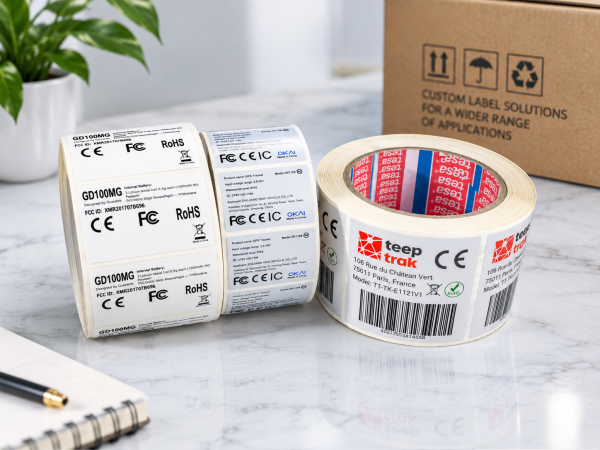
Industrial compliance labels serve to identify products, communicate safety‑related information, and support traceability while meeting applicable regulatory or industry requirements. However, compliance labeling involves more than just printing correct information. The label material, adhesive, printing method, durability, and application substrate must all adapt to the label’s actual service environment.
For manufacturers, original equipment manufacturers (OEMs), and industrial purchasers, a properly specified label should remain legible, securely attached, and functional throughout its expected service life. Choosing suitable custom industrial labels starts with understanding both the information the label must display and the conditions it must withstand.
- What Are Industrial Compliance Labels?
- Why Compliance Labels Are More Than Printed Text?
- Key Information Required by Application
- Understanding the Difference: Regulations, Standards & Certifications
- Integrating Traceability: Barcodes, QR Codes & Serials
- What to Prepare Before Ordering Custom Compliance Labels
- FAQ
- Need Help Customizing Your Own Packaging Design?
What Are Industrial Compliance Labels?
Industrial compliance labels are custom labels used on machinery, electrical equipment, chemical containers, automotive components and other manufactured products to communicate product identification, safety, traceability, certification and other required information.
Industrial compliance labels help manufacturers communicate information throughout the product lifecycle support product traceability and meet applicable regulatory, industry or customer requirements. However there is no compliance label specification that applies to every industrial product. The information required depends on the product, target market, applicable regulations, certification requirements and customer specifications.
As an example, the GHS is a system for the classification and communication of hazards of chemical substances and mixtures. In the United States OSHA’s Hazard Communication Standard tells us exactly what must appear on the labels of containers that carry chemicals. The label must show the product identifier the word, the hazard statements the pictograms, the precautionary statements and also the name, address and telephone number of the person or company that is responsible.
In markets and for other product groups there can be different rules for marking, safety, certification or labeling. For example if a product goes to the EU market it may need a CE marking under the EU law. Meanwhile the EU General Product Safety Regulation creates safety duties, for any product that falls under its rules.
Why Compliance Labels Are More Than Printed Text?
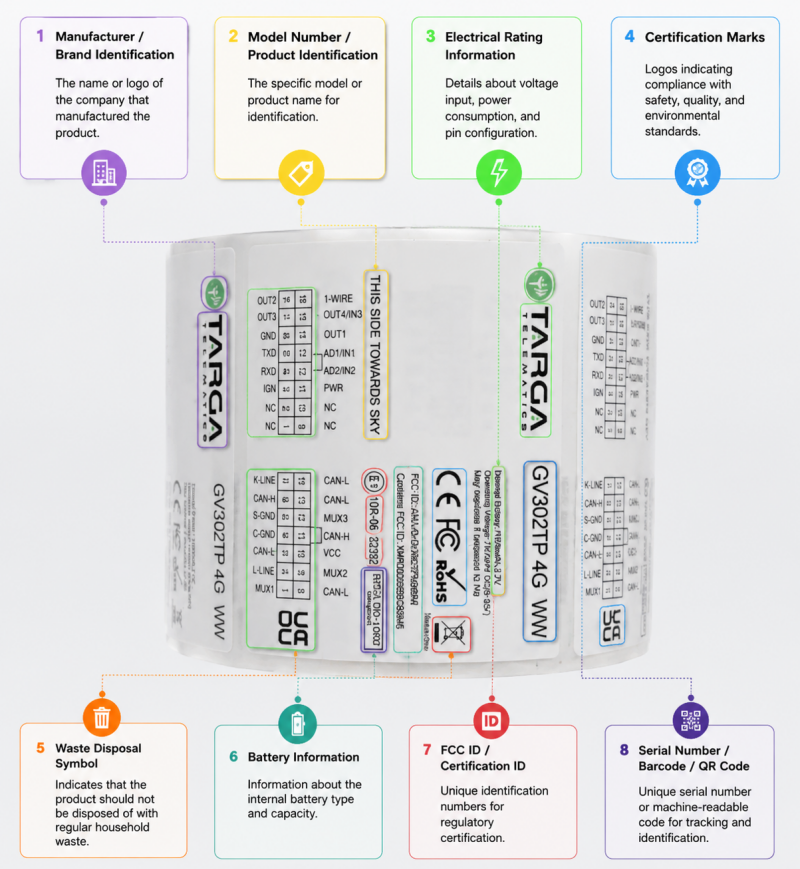
Industrial compliance labels go well beyond showing basic product information. Based on application scenarios, they facilitate safety communication, product identification, traceability and supply‑chain management.
Product Identification & Safety Communication
Labels display model numbers, manufacturer data, safety warnings and operating instructions. For regulated products, content and formatting must follow relevant regulations. Besides accurate content, labels shall stay legible throughout their intended service life.
Traceability & Digital Identification
Barcodes, QR Codes, Data Matrix codes and serial numbers connect physical items with inventory, production, inspection and maintenance records. Integration simplifies scanning for OEMs and industrial buyers and removes extra identification stickers. Code size, print quality, contrast and available label space need consideration during design.
Durability for Industrial Environments
Labels resist heat, oil, chemicals, moisture, sunlight and abrasion. Performance relies on face stock, ink, adhesive and protective coating. Material selection should prioritize working surfaces and conditions instead of appearance, to guarantee reliable adhesion and readability under harsh conditions.
Supply‑Chain & Quality Management
Standardized labels ensure consistent product ID through production, storage, distribution and after‑sales service. Batch, serial and inspection data support internal quality control. Verify label specifications prior to production rather than blindly applying generic templates, as market and customer requirements differ.
Key Information Required by Application
The required information varies by product and regulation. Before designing a label, manufacturers should identify which information is legally required, which information is needed for traceability, and which information is specified by the customer or OEM.
| Application | Common Information |
|---|---|
| Chemical products | Product identifier, hazard information, pictograms, precautions |
| Industrial machinery | Model, serial number, warnings, manufacturer information |
| Electrical equipment | Ratings, identification, warnings, applicable certification information |
| Automotive components | Part number, barcode, batch or serial information |
| Industrial containers | Product identification, handling and safety information |
| Equipment and assets | Asset ID, serial number, barcode or QR code |
| Inspection labels | Inspection status, date, inspector or service information |
For hazardous chemicals covered by OSHA’s Hazard Communication Standard, the label requirements are more specific than a general industrial identification label. Always verify the applicable regulation for the product and market rather than assuming that one standard covers every label.
Understanding the Difference:
Regulations, Standards & Certifications
For professionals new to industrial procurement, compliance, certifications and customer specific requirements are three concepts that are easily confused. Some previous clients assume their labels satisfy all compliance requirements simply because correct marks or warning symbols have been printed. This is not the case — the three are entirely distinct.
Regulations represent the legal baseline that products must follow. Regulations such as OSHA and GHS establish mandatory legal requirements for product safety, environmental protection and other aspects.
Standards define detailed technical or safety guidelines. For example, ANSI standards impose strict rules for label colors, layout and the severity level of warning statements.
Certifications refer to compliance marks authorised after verification of specific products by third-party bodies (e.g. UL, CSA). Official rules governing reproduction and size-proportions for these marks are typically extremely stringent.
Beyond these statutory compliance requirements, customers (OEMs, for instance) may issue their own proprietary label specifications. Customer specifications often incorporate regulatory obligations together with additional commercial and engineering demands, such as brand visuals, traceability management or designated label placement.
Before label printing, confirm these key points: Which regulations or standards apply to this product? Are particular certification marks required? Does the certification body specify rules for mark reproduction? What core information must appear on the label? How long shall the label remain legible and firmly adhered?
A clear understanding of the boundaries and overlaps among regulations, standards, certifications and customer specifications helps industrial labels deliver proper compliance endorsement and safety warnings. It also prevents legal risks and product return losses caused by misunderstanding these concepts.
Integrating Traceability: Barcodes, QR Codes & Serials
Modern manufacturing no longer separates compliance labeling from inventory management. Leading OEMs and manufacturers integrate 1D barcodes, QR codes, Data Matrix codes and serial numbers directly into standard compliance labels. Combining regulatory warnings and traceability data on a single custom label eliminates extra tracking stickers, reducing material and labor labeling costs.
1D barcodes streamline global warehouse scanning and inventory control. Compact QR and Data Matrix codes fit limited surfaces, allowing instant mobile access to SDS documents, manuals, technical data and digital compliance certificates. Unique serial and batch numbers build tamper-proof links between physical products and their production, testing and maintenance records for reliable quality and warranty tracking.
This integrated solution delivers full lifecycle visibility, precise batch recalls and simpler quality audits to avoid costly downtime. Combined with anti-tamper adhesive and micro-text features, the codes also prevent counterfeiting.
What to Prepare Before Ordering Custom Compliance Labels
| Category | Specification Item | Details & Requirements |
|---|---|---|
| 1. Basic Info & Compliance Documents | Product & Manufacturing Info | Provide detailed product name, model number, manufacturer name and full address, country of origin, product identifiers (batch/serial/SKU), and applicable execution standard numbers. |
| Responsible Party & Qualification | Prepare responsible entity details according to target markets (e.g., EU REP, US Agent). Ensure legal entities match shop/production details, and prepare compliance certificates (CE, FCC ID, UKCA, etc.) for verification. | |
| 2. Layout, Format & Dimensions | Dimensions & Layout | Determine recommended label size based on packaging dimensions and platform rules (e.g., standard compliance label 100mm × 100mm, shipping label 10cm × 15cm), leaving sufficient area for information display. |
| Text & Mark Specifications | Confirm official language requirements of the target market. Ensure mandatory certification marks (e.g., CE mark) meet standard height and aspect ratio rules without distortion or stretching. | |
| 3. Material & Application Method | Material Selection | Select facestocks suited for actual service conditions (waterproof, oil-proof, abrasion, high temperature, or chemical resistance like Matte PET, Synthetic Paper, Heat-Resistant Film) to avoid label peeling or smudging during transport. |
| Application Guidelines | Confirm label placement (e.g., side of drum, end face of box) to ensure labels adhere firmly and smoothly without being covered by secondary labels or shipping documents. | |
| 4. Information Consistency & Traceability | Information Verification | Rigorously verify that label text strictly matches physical goods, certification documents, and backend platform registration records before ordering to prevent omissions or discrepancies. |
| Traceability System Integration | If full-chain tracking is required, plan generation rules for 1D barcodes, QR codes, or RFID tags in advance, ensuring seamless integration with existing ERP/MES systems or cloud storage platforms. | |
| 5. Verification & Audit Materials | Physical Product Photos | Some platforms or auditors require physical product-and-label photos under natural light. Renderings or edited images are not accepted; prepare actual items for upload and review. |
| Third-Party Audit Documentation | For complex chemicals or specialized equipment, prepare SDS (Safety Data Sheets) or ingredient declarations in advance for third-party compliance review (e.g., CMA/CNAS accredited testing labs). |
FAQ
What are industrial compliance labels and why are they mandatory?
What is the difference between regulations, standards, and certifications?
How do barcodes and QR codes integrate into compliance labels for traceability?
Which materials are recommended for harsh industrial environments?
What mandatory elements must appear on GHS chemical compliance labels?
What should I prepare before ordering custom compliance labels?

Need Help Customizing Your Own Packaging Design?
Whether you need Cosmetic Labels, Wine Labels, Food Labels, or Custom Adhesive Stickers, our experts can recommend the best material based on your product, application, and budget.