
Why Are Custom Label Quotes Different Between Suppliers? A Guide for Buyers
Even if you have provided the same label design and order quantity to several custom label suppliers, you can expect to receive significantly different custom label quotes. The main reasons include material specifications, printing methods, production capabilities, quality-control standards, finishing processes, and shipping terms.
A lower price quote does notalways translate to lower production cost for custom labels.Even though you may order exactly the same quantity of labels with the same custom label design from different suppliers, the supplier quotes can vary greatly. These differences can affect both the quoted price and the final performance of the labels.
For B2B buyers, comparing the total cost, specifications, production process, quality standards, and delivery terms is often more useful than comparing the unit price alone.
The following factors explain why different label manufacturers may provide different quotes for the same custom label project.
| Quote Factor | What Can Be Different Between Suppliers | How It Affects the Quote |
|---|---|---|
| Material | Film grade, adhesive, liner and raw-material supplier | Higher-quality materials can increase material costs |
| Printing Method | Digital, flexographic, offset or other processes | Setup costs, production speed and volume affect pricing |
| Finishing | Foil stamping, embossing, spot UV, lamination and other finishes | Additional equipment, labor and processing increase costs |
| Production Capability | In-house equipment, automation and production capacity | Outsourcing and additional setups can increase costs |
| Quality Control | Inspection, color control, die-cut accuracy and packaging | More QC steps increase labor and production costs |
| Order Volume | Quantity, designs and production runs | Fixed setup costs are spread across more labels at higher volumes |
| Shipping Terms | FOB, CIF, DDP, freight method and destination | Freight, customs, duties and other costs can change the final price |
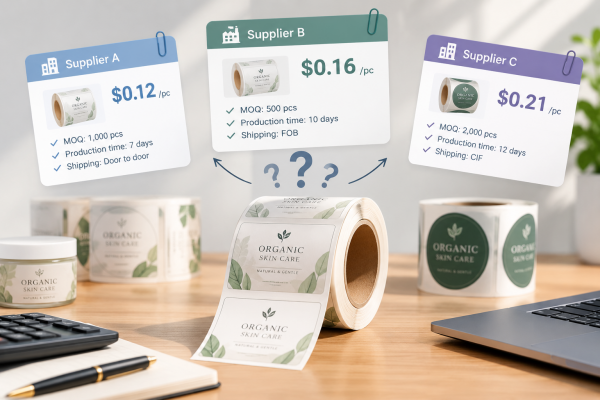
What Causes Differences in Custom Label Quotes?
Material Sourcing & Quality Differences
Even if two suppliers list the same material name (such as BOPP or PET), actual specifications and quality may vary. Film grade, adhesive system, liner stock and upstream raw-material sources all affect label performance and production costs.
Raw-material quality is a key reason for price gaps among label vendors. Some manufacturers cut costs by using low-cost materials from lesser-known material suppliers. While these materials meet basic requirements, certain performance will be compromised.
In contrast, manufacturers working with reputable material suppliers like Avery Dennison or UPM Raflatac receive materials with stricter quality control and better batch-to-batch consistency. Though material costs are higher, improved reliability reduces risks of color deviation, adhesive failure and other label-related issues during application.
Another pricing factor is the supplier’s position within the supply chain. End-manufacturers with full-range in-house production capacity purchase directly from qualified raw-material suppliers without multiple middlemen. This eliminates extra mark-ups from distributors and traders, allowing clearer cost breakdowns.
For custom labels with identical material specs, printing method, finishing processes and order quantity, direct manufacturers generally offer more competitive pricing than resellers. Their quotations tend to be easier to verify, with transparent details covering materials, processes and extra charges.
Printing Equipment and Production Capability
Printing equipment and overall production capacity are also key factors affecting custom‑label pricing. Differences in printing machines, automation systems and production processes directly impact production efficiency, product consistency and overall manufacturing costs.
Modern label manufacturers equipped with advanced printing machines and automated systems deliver better color consistency, higher productivity and more reliable quality control. These advantages are especially valuable for large‑volume orders or brands requiring repeated re‑runs of the same design.
Apart from core printing presses, a manufacturer’s capability for various post‑press finishing also influences final quotations. Processes such as hot stamping, embossing, spot UV, lamination and special adhesive application require extra dedicated equipment, skilled operators and proper production management.
Suppliers with lower‑priced quotations may suffer from limited machinery or incomplete in‑house finishing workflows. This can lead to longer lead‑times, fewer available finishing options and inconsistent quality across different production batches.
When comparing label suppliers, businesses should not only focus on unit prices, but also comprehensively evaluate the manufacturer’s production capacity, equipment investment and its ability to maintain consistent quality throughout the whole order cycle.
Businesses comparing suppliers should also consider whether the manufacturer has experience producing labels for their specific application, including food labels, cosmetic labels, industrial labels, and other specialized products.
Quality Control and Production Standards
Price variations among label quotes arise because manufacturers incur differing costs for management, equipment, and labor to ensure delivery quality. The process from printing to shipment involves multiple, often unseen, quality control steps.
Higher end facilities have strict controls in place to ensure color consistency, accurate die cutting, surface defects such as specks or scratches, printing errors, correct winding direction and adequate protective packaging.For export orders, high-quality manufacturer reinforce our packaging to withstand long distances to your location and to be compatible with your application machinery.Though these quality controls may not be immediately obvious,they create hidden costs in terms of labor and time.
The production of high-quality products demands the highest standards for the precision of equipment and the control of processes.High-precision manufacturing increases equipment depreciation costs and results in higher material waste during the setup and calibration phases. In addition, some industries have specific certification requirements which manufacturers must obtain and which have to be renewed on an annual basis and thus are included in the production costs.
This type of low price quotation is usually provided at the cost of lower production standards and less quality control. Such products might suffer from problems such as edge lifting,detaching, color fading or even failing to read. These types of defects can lead to costly rework, replacement orders, even equipment failure, safety issues and liability. Some industries even require manufacturers to obtain special certifications that must be renewed on an annual basis. These costs too are factored into a manufacturer’s production costs.
Production Capability
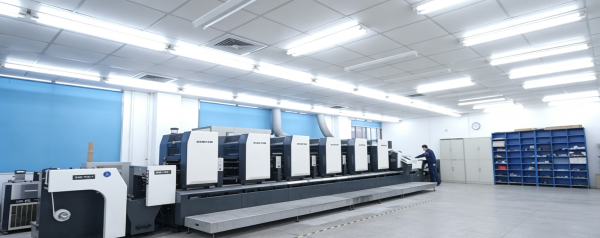
Production capacity is not only reflected in the number of machines, but also in production-line conditions: automation level, in-house post-processing facilities, overall output scale and scheduling capability.
Manufacturers with solid production capacity can complete post-processing internally. Automated inline equipment enables continuous printing, lamination and die-cutting. This cuts semi-finished-goods handling, labor transfer and material waste from repeated setup. For large-volume orders, priority scheduling helps spread fixed startup costs for more competitive pricing.
By contrast, suppliers with limited capacity lack full-range equipment. They have to outsource processes such as hot stamping and spot UV. Extra costs arise from transit, loading-unloading and second-time machine setup. When orders exceed their output limit, full subcontracting adds third-party profit margins.
In addition, older equipment slows job change-overs and creates more trial-run scrap. Higher waste is passed into label quotations. Even with identical raw materials, gaps in in-house production facilities can lead to big differences in final quotes.
Shipping Terms and Additional Costs

Terms like FOB, CIF and DDP cover different scopes of obligation and cost allocation, including different freight rates, customs clearance, taxes and other costs and risks.The cost of transport also varies depending on the type of transport, with low cost sea freight having long delivery times leading to stock piles and capital lock up. Land transport is a balanced choice between cost and time, making it suitable for short to medium term replenishment of stock into neighboring countries.Air freight is more expensive but delivers very fast and is suitable for small quantities to avoid stock risks and to keep total costs low. The modes of transport can vary depending on the distance between the manufacturer and the destination and thus the end price will also vary.
Are Roll Labels Cheaper Than Sheet Labels?
Roll labels are not automatically cheaper than sheet labels. Final pricing depends mainly on your order volume and how you will apply the labels.
Most professional sticker presses work in roll-to-roll mode. For large-volume orders, printing, die-cutting and waste stripping run inline on one production line. No separate cutting and separating work is needed. This saves labor time and material loss from secondary processing. Finished labels are wound onto paper cores for shipment. They fit directly onto automatic labelling machines. Therefore, roll labels usually have a clear price advantage for large runs.
For small-volume jobs, however, roll labels may not be cost-effective. Extra work is required for rewinding and core mounting, and many factories set a higher MOQ for roll production. Sheet-format delivery skips rewinding steps and may offer better pricing for small orders.
Still, sheet labels have their disadvantages. They require an extra post production cutting and separating process. As order quantities grow, accumulated labor and cutting waste gradually push up the unit cost, making sheet labels more expensive than rolls at higher volumes.
Your application method also matters. Even if roll labels cost slightly more, they are preferred for automatic production lines. Sheet labels are hand-friendly for manual application with small usage.
FAQ
Why do different label manufacturers quote different prices for the same specifications?
What should I compare when reviewing custom label quotes from different suppliers?
Does a lower custom label quote always mean lower quality?
How do material and adhesive specifications affect custom label pricing?
Are roll labels cheaper than sheet labels for bulk orders?
How can I compare custom label quotes accurately before placing an order?

Need Help Customizing Your Own Packaging Design?
Whether you need Cosmetic Labels, Wine Labels, Food Labels, or Custom Adhesive Stickers, our experts can recommend the best material based on your product, application, and budget.