
Adhesive Die Cutting Process:
The Ultimate Guide for Custom Stickers

The die cutting process of adhesive materials are different from traditional printing materials.
Traditional die cutting processes primarily involve two main functions: cutting and creasing, and are suitable for standard paper and cardboard and requires cutting completely through the paper or cardboard.
It primarily involve two main functions: cutting and creasing, and are suitable for standard paper and cardboard. When cutting completely through the material, pay special attention to cutting integrity and edge smoothness.
The die-cutting of adhesive materials only involves cutting through the surface material and adhesive layer. At the same time, the cutting depth must be strictly controlled to avoid damaging the backing paper.
The key is to preserve the backing paper and its silicone coating. This ensures that the die-cut labels or stickers remain properly attached and prevents them from failing due to damage to the bottom layer.
How to Improve the Die Cutting Process Quality?
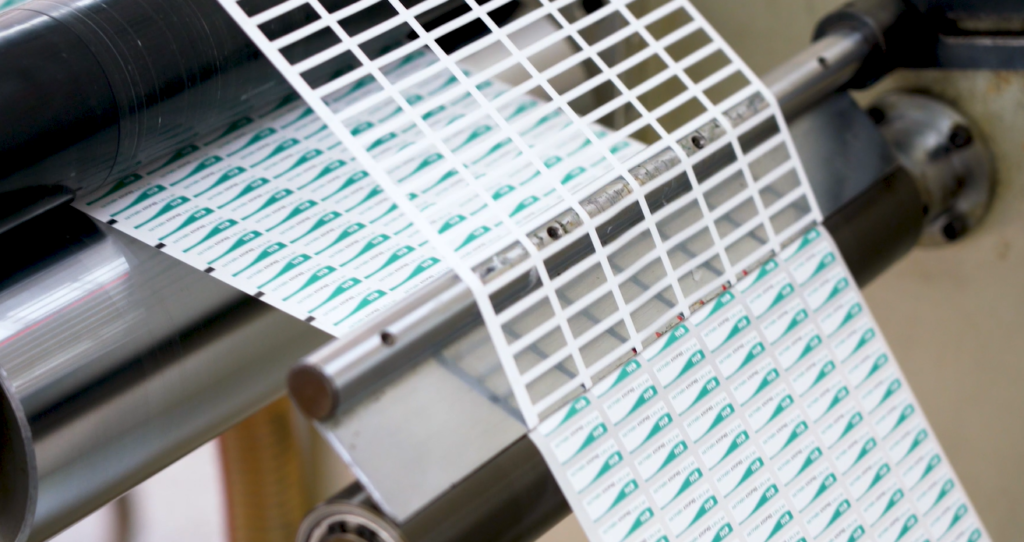
In the production of self-adhesive labels, die cutting process quality has the same status as printing quality.
The quality of die cutting directly affects the subsequent steps of label processing and the quality of the finished product.
To improve its quality, attention should be paid to these three aspects:
Die Precision
The accuracy of the die is the basis for quality improvement.The blade angle needs to be matched according to the material.
Use a 45° blade for paper materials and a 30° blade for film materials to ensure a smooth cut surface without pulling.
Also, the knife height is controlled within ±0.02mm.
A flat pad is used to cut the face material without cutting the backing paper.Regular maintenance and replacement of the knife and knife pad are required to avoid basic defects.
Process Parameters
Control the critical die-cutting pressure (0.2–0.5MPa) to eliminate problems such as glue overflow and incomplete cutting;
adjust the die cutting process speed as needed to produce flexible materials at low speed and reasonably speed up paper materials.
Precisely control the rewinding and unwinding tension, cooperate with dust removal and reasonable waste discharge angle to ensure stable production.
Material Adaptation
Paper materials are used with water-based glue, and film materials use solvent-based glue with greater stability.Before using the materials, leave them in a constant temperature and humidity environment for 24 hours.
This releases internal stress and prevents deformation or size changes. Three-dimensional collaboration can stabilize the die-cutting quality.
| Comparison Aspect | Kiss Cut Process (Adhesive Labels) | Traditional Die Cut (Paper/Cardboard) |
|---|---|---|
| Cutting Depth | Partial cut: Cuts through facestock and adhesive layer only. | Full cut: Cuts completely through all material layers. |
| Liner / Backing Integrity | Fully Preserved: Release liner & silicone coating remain completely intact. | Completely Severed: No liner present or backing paper is fully cut through. |
| Primary Function | Precision depth control, enabling easy label peeling & matrix stripping. | Shape contouring, folding creases, blanking, and total part separation. |
| Main Applications | Self-adhesive labels, sheet/roll stickers, film overlays, and decals. | Folding cartons, packaging boxes, hang tags, and cardboard displays. |
| Key Critical Control | ±0.02mm blade height accuracy & pressure calibration. | Edge sharpness, die durability & smooth cut margins without burrs. |
The Influence of Adhesives on Die Cutting Process
There are four types of adhesives commonly used in adhesive materials: acrylic water-based latex, rubber hot melt adhesive, solvent based rubber,and acrylic adhesive.
Among them, acrylic water-based latex and hot melt adhesive are the most widely used. Due to different raw materials and formulations of adhesives, their physical and chemical properties are also different.
Water-based latex is composed of micro-particles with relatively lower cohesive strength. Even if the adhesive layer is not 100% severed during die-cutting, the tension applied during matrix stripping easily snaps the adhesive film, allowing smooth waste removal without tearing the labels.
On the other hand, hot melt adhesive features high internal cohesion and rubber-like elasticity, making it highly resistant to separation. During die-cutting, any slight inaccuracy can lead to severe issues: if the pressure is too light, the tacky adhesive will form “bridges” and pull the active labels off with the waste skeleton; if the pressure is too heavy, it will cut through the release liner.
During the die-cutting process, even if a water-based latex adhesive layer isn’t completely cut through, the waste matrix can still be removed effortlessly. The tensile force applied during matrix stripping easily breaks the latex adhesive layer.
In contrast, hot melt adhesives have high cohesion and elasticity. If die-cutting isn’t precisely calibrated, the uncut hot melt adhesive will create ‘stringing’—causing the main labels to be pulled off alongside the waste matrix, or forcing operators to over-press the die and cut through the release liner.
Frequently Asked Questions: Die Cutting Process
1. What is the adhesive die cutting process in custom label manufacturing?
The adhesive die cutting process is a precision manufacturing method used to shear, shape, and cut various adhesive-backed materials into specified dimensions. In custom label manufacturing, this process typically involves cutting through the label facestock and adhesive layer while leaving the backing material (release liner) completely intact, allowing for easy peeling and application.
2. What is the difference between Rotary and Flatbed die cutting?
Rotary Die Cutting: Uses cylindrical dies on a rotating press. It is optimized for high-speed, high-volume production with excellent dimensional consistency, ideal for roll-fed labels.
Flatbed Die Cutting: Uses a flat hydraulic press to stamp out shapes. It is best suited for low-to-medium volumes, thicker rigid materials, and low-cost tooling setups.
3. How do you prevent material flagging or curling during the cutting process?
Preventing flagging requires a technical balance between blade sharpness, depth calibration, and material tension. At our factory, we analyze the stiffness of the lamination and facestock to precisely fine-tune the die’s striking depth, ensuring the liner is not scored, which preserves the adhesive’s edge integrity and prevents post-application lifting.
4. Can laser die cutting completely replace traditional mechanical dies?
While digital laser die cutting offers extreme flexibility for intricate geometries without the need for physical tooling (perfect for short runs and prototypes), traditional mechanical dies (rotary/flatbed) remain the gold standard for large-scale B2B production due to their superior throughput speeds and cost efficiency per million units.
5. How does the die cutting process handle complex, irregular custom shapes?
Complex geometries are handled via precision CAD engineering. We transform your vector designs into highly accurate tooling files. During production, specialized matrix stripping systems are utilized to cleanly remove the intricate die-cut waste without tearing the actual custom stickers or pulling them off the liner.
6. What details should a buyer provide to the factory to optimize the die cutting outcome?
To ensure perfect execution, buyers should provide: the exact vector outline of the custom shape, the application method (hand-applied or high-speed automatic labeling machinery), and the target storage environment (such as high-temperature filling or low-temperature cold chain storage) to allow proper tolerance engineering.

Need Help Customizing Your Own Packaging Design?
Whether you need Cosmetic Labels, Wine Labels, Food Labels, or Custom Adhesive Stickers, our experts can recommend the best material based on your product, application, and budget.