
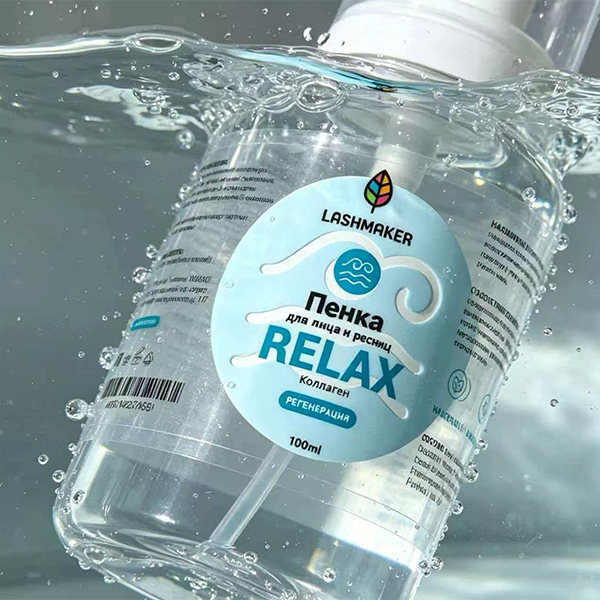
Waterproof cosmetic labels have one of the key advantages in delivering excellent waterproof performance.Many cosmetic products are used in humid environments, such as bathrooms, swimming pools or even outdoors. Cosmetic labels without water resistance will become wrinkled and develop creases when they absorb moisture. Furthermore, any written information printed on the label (such as batch numbers, best before dates, etc.) will become blurred and unreadable. This not only causes unnecessary inconvenience for consumers but also leaves them with a poor impression of the brand.
This guide will analyze how to select and test the water resistance of these cosmetic labels, with the hope of helping manufacturers in the beauty industry avoid the situations described above.
What Makes Cosmetic Labels Truly Waterproof?
A common mistake people often make is choosing cheaper paper as the label face stock to save costs, assuming that applying a protective film to the surface is all it needs to make the labels waterproof.
But that’s not actually the truth. A truly waterproof and durable label consists of multiple components, including the face stock, adhesive, and printed graphics. If even one of these parts fails, the label cannot be fully waterproof.
Why Waterproof Film Alone Is Not Enough
A label that looks like a single sheet of paper actually is made of several layers: the face stock, the adhesive and the release liner.Laminating can only be applied to the outermost layer, thus after cutting the sides of the label are still exposed.The label edges are not covered during the curing of the label and moisture can penetrate between the face stock and adhesive of the label. Over time this will cause the label to blister,delaminate and curl.
Only full encapsulation can completely seal all sides; standard lamination processes cannot achieve this. From a cost-effectiveness perspective, it is better to choose waterproof materials directly.
The Roles of Facestock, Adhesive and Ink
- Face Stock: It’s the base material of your label,where as synthetic materials like BOPP and PET are preferred for waterproof cosmetic labels as they repel moisture, oil and cosmetic liquids. Paper materials even laminated will swell up when coming into contact with water.
- Adhesive: The adhesive holds the label to the containers.Waterproof acrylic adhesive is necessary to prevent the label from lifting off due to humidity, oil, or alcohol.
- Ink: Color and information carrier. Waterproof / solvent-resistant inks avoid bleeding, fading or dissolving when contacting lotions, essential oils and alcohol-based cosmetics.
Waterproof vs. Splash-proof Cosmetic Labels
Simply put, waterproof labels are “completely immune” to moisture, whereas splash-proof labels are only capable of “resisting minor” exposure to moisture.
Waterproof labels are completely immune to moisture, where as splash-proof labels only resist minor contact with moisture, oil etc.
They have a complete moisture barrier and are totally waterproof, meaning they can be submerged for long-periods, be subjected to moisture, wetness, and even frost. The label and print remain intact, neither peeling nor wrinkling, nor does the print smudge or fade.
Splash-proof labels only offer a limited protection against moisture and oil. This type of label resists minor splashes, temporary contact with wet conditions and light condensation.
However, it is not possible to submerge the label completely for a longer period.They will eventually degrade, become damaged, or lose their adhesive properties.
| Feature | Waterproof Label | Splash-proof Label |
| Core Function | Fully withstands immersion, oils, and high humidity. | Resists light splashes, wiping, and minor moisture. |
| Ideal Environment | Bathrooms, outdoor use, or refrigerated storage. | Dry vanities, bedrooms, or indoor retail displays. |
| Typical Products | Shampoos, body washes, sunscreens, and squeeze tubes. | Powder makeup (eyeshadows), perfume, and outer paper boxes. |
| Key Warning | Mandatory for wet environments to prevent peeling, fading, and customer complaints. | Cost-effective choice for dry environments; do not use for wet products. |
Which Waterproof Cosmetic Label Material Fits Your Product?
| Label Material | Best-Fit Cosmetic Packaging | Key Advantages | What to Verify Before Production |
|---|---|---|---|
| White BOPP | Shampoo bottles, lotion bottles, cleanser packaging | Water-resistant, tear-resistant, and suitable for vibrant, high-contrast graphics. | Adhesion on the container, moisture exposure, and resistance to repeated handling. |
| Clear BOPP | Transparent skincare bottles, serum packaging, minimalist cosmetic containers | Creates a clean, no-label-look effect while allowing the product or container color to show through. | Clarity, air bubbles, edge lifting, and whether white ink is needed for opaque graphics. |
| PET Film | Premium skincare bottles, rigid cosmetic containers, applications requiring dimensional stability | Good dimensional stability and durability for applications where label shape retention matters. | Adhesive compatibility, container curvature, surface finish, and resistance to the intended exposure. |
| PE Film | Squeezable lotion bottles, flexible tubes, deformable cosmetic packaging | Flexible construction can better accommodate packaging that bends or deforms during use. | Flexing, repeated squeezing, wrinkling, edge adhesion, and recovery after deformation. |
| Protective-Laminated Film Labels | Skincare, personal care, and cosmetic packaging requiring additional surface protection | A compatible laminate can improve resistance to scuffing, moisture, and everyday handling. | Laminate compatibility, edge sealing, print adhesion, and resistance to the actual cosmetic formula. |
Important: Waterproof performance depends on the complete label construction, including the facestock, adhesive, printing system, protective finish, and container surface. No material guarantees reliable adhesion under every condition. Test the finished label on the actual packaging before approving bulk production.
If you would like to learn more about how to select cosmetic ingredients, please take a look at this article of ours—”How to Choose the Best Cosmetic Label Material?“
How to Test Waterproof Cosmetic Labels Before Bulk Production
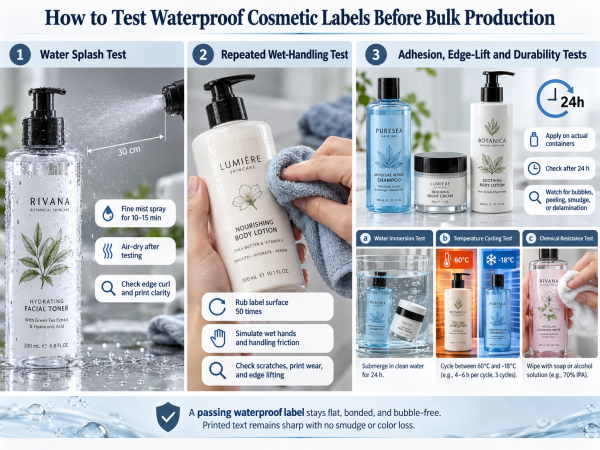
If cosmetics brands wish to verify whether the water resistance of their labels meets their requirements prior to mass production, the manufacturer may be asked to conduct the following tests:
Water Splash Tests
This test is aim to evaluate a label’s water resistance against everyday splashes.If your product is a cosmetic intended for outdoor use or one that may occasionally be exposed to moisture, you might want to try this test.Expose the label to a fine-mist (fine spray) from a faucet or sprayer for 10-15 minutes. This is done by holding the spray head at a distance of about 30 cm from the label surface and spraying it continuously for the specified time period.
After the spraying process let the label air-dry for a while. Gently press the edges of the label to check if they curled up or even started to peel off. After the label has dried completely inspect the printed surface for moisture penetration. If the printed text is still clear and complete the label passed the test.
Repeated Wet-Handling Tests
This test evaluates wear resistance for hand soap and skincare labels. These labels are often touched in wet conditions and subject to force from handling or wet hands.
Using a slightly damp cloth, firmly rub the label surface 50 times to simulate contact with wet hands and handling friction.
After rubbing, check for scratches or surface damage. Confirm if print wears away to expose the base material. Also check if the label edge lifts or peels from the bottle from combined moisture and rubbing.
Adhesion, Edge-Lift and Durability Tests
We recommend using your actual cosmetic containers. Apply the labels and first check for loose adhesion right after application. Let the bottles sit for 24 hours. Check for edge lifting, peeling or bubbles at this initial stage.
To test water resistance and edge stability, run aging tests on labeled bottles under extreme conditions:
- Water immersion test: Submerge bottles fully in water, sometimes for multiple days. Watch for bubbles or label separation.
- Temperature cycling aging test: Place bottles in an oven at 60°C for several weeks, or in a freezer at -18°C for 24 hours or longer. Check for adhesive oozing, edge lifting or delamination under humid hot-cold shifts.
- Chemical resistance test: Wipe labels with a cloth dampened with hand soap, body wash or alcohol. Check resistance to common cosmetic chemicals.
A passing waterproof label must stay flat, bonded and bubble-free. All printed text and graphics stay sharp with no smudge or color loss. If lifting or separation happens, the adhesive does not work with your bottle material, and a new label formula is needed.
Why Waterproof Cosmetic Labels Peel, Bubble or Lose Print Quality
Moisture-Related Adhesion Problems
Just because a facestock is water-resistant, does not necessarily mean that the label will adhere well in wet conditions. In particular, labels may lift off when moisture penetrates to the adhesive interface. When selecting a label for a container, the material of the bottle itself can greatly affect how a label will stick. Containers are made of materials such as glass, PET, HDPE, and PP. Each of these has a unique surface, so a good sticking adhesive on one type of bottle may not perform as well on another.
How to reduce the risk:
Check the containers for cleanliness, dryness and compatibility with the chosen adhesive. Always test the labels on the actual bottles and jars and not on flat material samples.Edge adhesion test after exposure to moisture and storage conditions.
Air Bubbles and Edge Lifting on Curved Containers
Bubbles and wrinkles on a waterproof label do not necessarily mean that the label has failed. Often the label has been applied to a container of incorrect dimensions, to a container with tapering sides or of irregular curved surface, or that there has been unequal application pressure.
Flexible tubes and small bottles like cosmetic containers are hard to label because their surfaces bend, compress or change shape when used.
How to reduce the risk:
Check the real area where your label will be applied before finalizing your artwork. Compare the size and shape of your labels to the corresponding area on your containers. Test the labeling process on your production containers. This is especially important if you’re using an automatic labeling machine.
Ink Scuffing and Surface-Finish Damage
The waterproof label material does not mean that all printed graphics are also resistant to all liquids, to all cosmetic raw materials and to all kinds of abrasion. Printing inks, coatings and laminates can react differently to friction, to oils and to alcohol containing products.Even if the labels remain firmly attached to the containers’ surface, the fine print on it can become hard to read after repeated handling or exposure to cosmetic formulations.
How to reduce the risk:
Select a printing and protective-finish combination appropriate for the expected exposure.
Check whether the label will come into contact with oils, lotions, cleansers, or alcohol-containing formulations.
Evaluate print clarity, color transfer, and surface damage under agreed testing conditions before approving a bulk order.
FAQ
Will applying a protective laminate alone make cosmetic labels fully waterproof?
What is the difference between waterproof and splash‑proof cosmetic labels?
What core components make a truly waterproof cosmetic label?
What tests should I run before mass‑producing waterproof cosmetic labels?
Why do waterproof cosmetic labels still peel, bubble or lose print quality?
Can I use splash‑proof labels for shampoo and body wash products?

Need Help Customizing Your Own Packaging Design?
Whether you need Cosmetic Labels, Wine Labels, Food Labels, or Custom Adhesive Stickers, our experts can recommend the best material based on your product, application, and budget.