
Squeeze bottles are made to flex during use. Labels must also flex and return to their original shape after being squeezed many times. Unlike the rigid glass bottle, the labels for this type of bottle must be tailored to the bottle’s shape, surface finish and use. Therefore labels intended for glass bottles are not necessarily suitable for use on squeeze bottles. Labels on squeeze bottles have to stretch and retract with the bottle during use.
What Actually Changes Between Squeeze Bottle and Glass Bottle Labels?
Labels for Squeeze Bottles
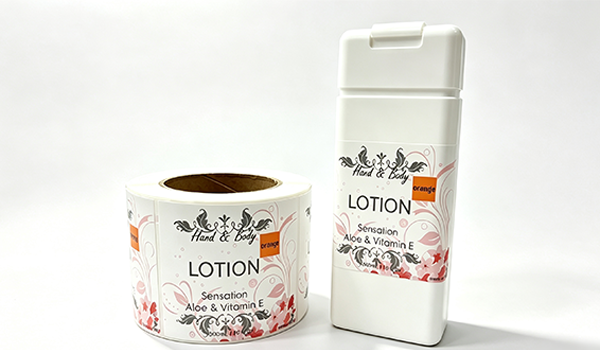
As squeeze bottles are used, they go through cycles of compression and rebound. This means that the label is subjected to constant peel stress. The peeling stress on the label can cause flagging or bubbling, especially if the label is not properly attached to the bottle or if the label is too stiff. Therefore, we prioritize the use of flexible label structures during the material selection phase. Labels with sufficient flexibility will conform to the bottle’s shape, preventing wrinkling and bubbling.
When selecting an adhesive, keep in mind that squeeze bottles are typically made of plastics such as PE or PP, which have poor surface adhesion.Generally speaking, oil-based adhesives offer relatively better bonding strength and are a suitable choice for labels on squeeze bottles. The evaluation of a label’s suitability depends on its actual performance under repeated compression and rebound cycles.
Labels for Glass Bottles
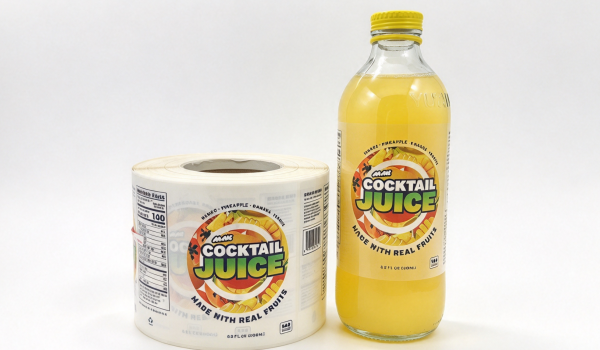
Although glass bottles do not deform, labels should not be too stiff. Bottles with small necks or irregular shapes have a high surface curvature; if the label material is too stiff or too thick, it can easily generate “rebound stress,” causing the edges to curl up. Ordinary flat labels applied to a conical surface are prone to wrinkling or trapping air. The label material and shape have to fit the bottle perfectly.Typically glass bottles provide a surface with better adhesion than plastic bottles.
Glass bottles also offer better surface adhesion than plastic bottles, so water-based adhesives are usually sufficient.They are commonly used for cosmetics, wine or beverages that require refrigeration,where freeze-resistant adhesives may be specified.
When selecting and evaluating labels for glass bottles, it is especially important to consider the surface and shape of the bottle, as well as the storage environment.
Can You Reuse the Same Label When Switching Bottles?
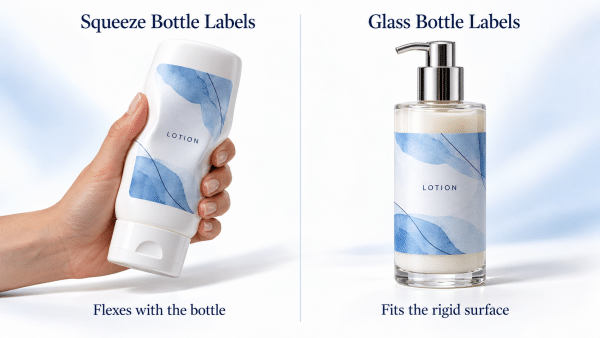
Having read the content above, you should now know that the answer is definitely—no, it’s not possible.The fundamental reason lies in the essential differences regarding the materials of the bottles, their physical properties, and the specific requirements for the label materials themselves.
But original design or artwork may be still retained where a change to bottle type occurs prior to production of labels.However, label material, adhesive and dimensions will need to be varied in order to meet new specifications.
When a brand changed from using glass bottles to squeeze bottles, for example, the logo and brand color scheme could remain the same but the new container could be deformed in use, and the original label structure would not be able to adapt.
| Label Element | What to Check When Switching Bottles |
| Artwork and colors | Keep the brand design, but confirm color, opacity, and finish on the new material. |
| Size and shape | Measure the new labeling area; the same bottle capacity does not mean the same label dimensions. |
| Material and adhesive | Review flexibility and adhesion on the actual container. |
| Lamination or coating | Check the finished label’s ability to accommodate squeezing, rather than evaluating the unprinted film alone. |
| Roll specifications | Confirm compatibility with the labeling equipment and any revised application settings. |
This verification is also required when changing from plastic bottles to glass bottles. Special attention needs to be paid to narrow-necked or tapered glass bottles. The label need to be shaped in a different shape or a more flexible material may be required in order to prevent flagging or bubbling.
Before placing a large order, be sure to conduct sample testing on the new packaging and ensure that the testing conditions match the actual filling, labeling, and usage environments. While maintaining the brand’s visual identity, ensure that the label specifications fit the new packaging containers perfectly.
How Should Buyers Compare Label Quotes for Both Bottles?
Note that the product (the label) may differ in its construction between different bottle types. If there are differences in the shape or material of the bottles provided, the corresponding label designs will also vary.A lower unit price is only good if the label is suitable for the packaging.
When comparing suppliers, send them the same information about the sizes of the labels and quantities that you need for each of the styles, the print information and where they need to ship from. It is very important to clearly specify the face stock, adhesive, and surface protection in the quotes. A label for a squeeze bottle will typically look very different from a label for a glass bottle.
Are the one-time charges for custom die-cutting, plate making,proofing etc. also included in the quotes and are these separate from the ongoing production costs for subsequent reprints? Can these costs be itemized as a one-off and separately quoted from the ongoing unit cost for future reprints?
Neither glass bottle labels nor squeeze bottle labels are automatically cheaper. Compare the total cost of a suitable specification, including sampling and delivery.
FAQ
Can I use the same labels on squeeze bottles and glass bottles?
Are waterproof labels also suitable for squeeze bottles?
Can BOPP labels be used on squeezable plastic bottles?
Will a stronger adhesive prevent labels from wrinkling or lifting?
Can I keep the same artwork and label size when changing bottles?
What information should I provide for a bottle label quote?

Need Help Customizing Your Own Packaging Design?
Whether you need Cosmetic Labels, Wine Labels, Food Labels, or Custom Adhesive Stickers, our experts can recommend the best material based on your product, application, and budget.