
How to Design Custom Honey Bottle Labels: A Complete Guide for Brands
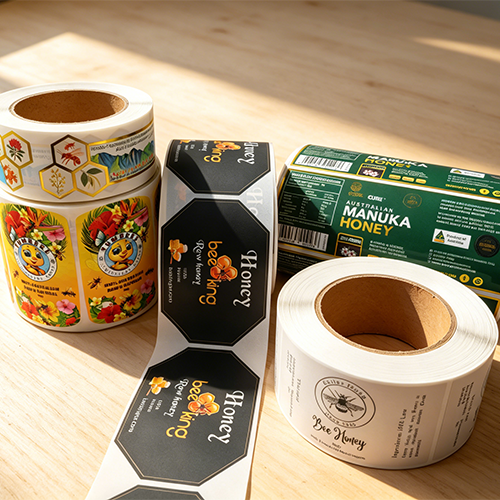
Custom honey bottle labels help honey brands build product identity, communicate essential information, and meet packaging requirements in different markets. Before printing, brands should consider label materials, sizes, design styles, finishes, and compliance information.
As a food product, honey products have clear food regulations in various countries around the world.Therefore, a successful honey bottle label design is not only an information carrier and a brand card, but also an important document for compliance and circulation.
If the label does not comply with local regulations, it is likely that the product will not be put on the market or will be refused import; it will face fines or administrative penalties; product recalls and other serious problems.
This article explains from four aspects: required elements of legal labels, label material and shape selection and standardized customization process.Designed as a systematic reference guide for honey producers at home and abroad for custom label solutions. It supports regulatory compliance, practical use and unique brand presentation.
- How to Create Your Custom Honey Bottle Label Design (Step-by-Step)
- Choosing the Right Materials and Shapes for Honey Bottle Label Design
- Film Labels
- Paper Labels
- Printing Options for Custom Honey Labels
- Popular Honey Bottle Label Shapes and Design Options
- What Must Be Included on a Legal Honey Bottle Labels Design?
- FAQ
- Need Help Customizing Your Own Packaging Design?
How to Create Your Custom Honey Bottle Label Design (Step-by-Step)

Step 1: Determine the circulation market and pre-compliance verification
First, identify the country, online platform, and offline channel where the product is sold, and obtain the latest bee product labeling regulations in the corresponding region. This step is foundational, as regional legal variations directly dictate the structural framework of your honey bottle label design.
Once the market is defined, finalize the text, logo, traceability code, and certification mark that must be marked. By locking in the text size and typesetting blank requirements in advance, you can prioritize the compliance framework within your overall honey bottle label design. This proactive approach prevents subsequent design changes, ensuring you avoid costly revisions and rework from the source.
Step 2: Accurately measure the size of the tank and finalize the label layout parameters
The circumference, height, and curvature of the honeypot body were actually measured, and the full-stick and half-stick pasting solutions were distinguished.
Leave a 2-3mm gap for the closing edge to prevent the label from warping.
At the same time, the background color of the label is determined based on the light transmittance of the tank.
It is recommended that dark-colored honey jars have light-colored labels to improve text readability; light-colored honey jars can be adapted to dark-colored brand labels to enhance visual contrast.
Step 3: Complete visual layout design combined with brand positioning
Original farm ecological brand: focusing on hand-painted flowers, beehives, and pastoral elements. The color scheme is mainly off-white, grass green, and earthy brown retro colors.
Urban light luxury supermarket brand: minimalist lines, low-saturated Morandi colors, and streamlined graphic and text layout.
Step 4: Material proofing+scene test verification
After completing the electronic version of the design draft, we will not directly print it in batches, but make corresponding material samples as needed.
Conduct actual measurements of water staining, sugar overflow, and high and low temperature refrigerated pasting.
Check for fading, warping, glue residue and all characters, numbers, origin codes, and qualification numbers for typos.
Step 5: Finalize color, batch printing and warehousing
After confirming that the proofing is correct, the printing color values will be unified to match the brand color system.
Laminating, hot stamping, embossing, and anti-counterfeiting processing are available as needed;
Batch finished labels are packaged in rolls and sheets.
Roll labels are suitable for automatic labeling machines and are suitable for mass production factories; sheet manual labels are suitable for manual can labeling on small farms.
Step 6: Optimize labeling adaptation and improve packaging closed loop
After batch labeling, check the overall aesthetics, adjust the labeling position, unify the bottle mouth and can label alignment standards, and complete the finalization of the entire set of private label honey packaging.
Choosing the Right Materials and Shapes for Honey Bottle Label Design

Film Labels
Honey is easily exposed to water vapor during storage and use or becomes damp due to cleaning the bottle.
Film labels such as BOPP and PET labels have good waterproof properties and come with a native waterproof and sugar-proof surface layer.
It can resist the erosion of honey overflow and condensation water without additional coating.
Honey products are prone to friction during transportation, storage and shelf display.
They have good wear resistance and can reduce printing pattern wear and blurred text.
This helps maintain the appearance of the packaging and the readability of the information.
Film labels also support a variety of design effects such as transparent, matte and hot stamping, taking into account practicality and brand image.
We don’t have to worry about their compatibility with the container.
We only need to choose the appropriate adhesive according to the surface material to get a better sticking effect.
Paper Labels
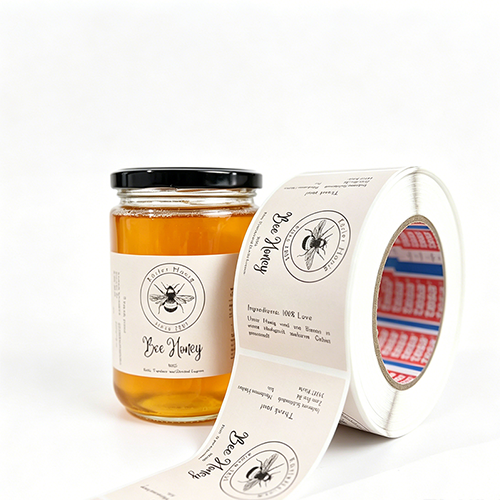
While BOPP and PET are the more common label materials used in honey packaging, paper labels still offer unique advantages.
Paper labels have their own natural paper texture, which can give honey products an original ecological texture.
Textured paper and kraft paper labels are more likely to convey a natural, handmade feel.
This is a visual and tactile effect that smooth and homogeneous film labels cannot provide.
At the same time, paper label raw materials and printing processing costs are lower, which can effectively reduce the packaging budget of small and medium-sized farms and start-up brands.
However, the original paper substrate has obvious shortcomings, such as poor waterproofing, sugar resistance, and wear resistance.
Condensation and honey overflowing from the tank can easily cause the label to wrinkle and degumm.
For honey products that require long-term storage or long-distance transportation, paper labels are generally not as durable as PET or BOPP.
The conventional improvement solution in the industry is surface coating treatment. Coated paper labels can greatly improve the waterproof and anti-adhesive properties.
This treatment can take into account the natural paper texture and basic moisture-proof durability.
Printing Options for Custom Honey Labels
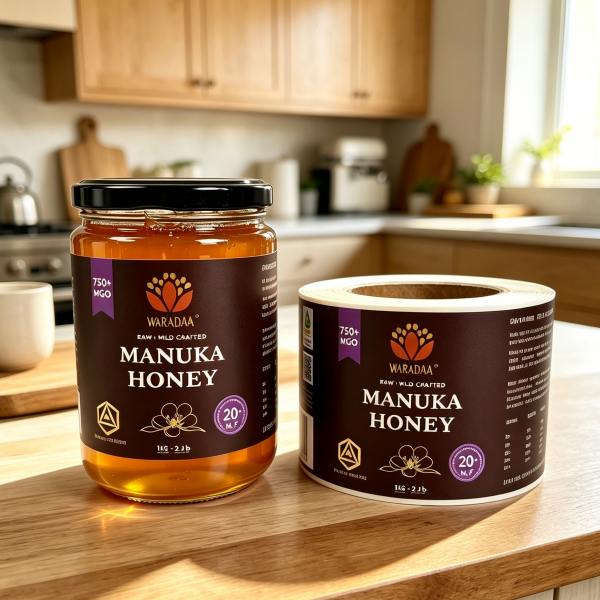
Printing Solutions for Custom Honey Labels
After finalizing your label design and material, the right printing method is critical for consistent quality, accurate color and efficient production. The optimal printing solution depends on your order volume, design complexity and specific application requirements.
Digital Printing for Small‑to‑Medium Batch Orders
Digital printing offers flexible options for honey brands requiring multiple designs, seasonal packaging or small‑run production. This process requires no printing plates. It delivers high‑resolution graphics and smooth color gradients with shorter lead times.
Flexographic Printing for Large‑Volume Production
Flexographic printing is widely used for mass‑production honey labels, especially roll‑format labels for automatic label applicators. It provides reliable color consistency and fast production speed with cost advantages for large orders.
Premium Processes to Highlight Brand Identity
Various surface finishing options enhance the texture and appearance of custom honey labels, including hot foil stamping, embossing, matte or gloss lamination, and clear‑label effects. These finishes give honey products distinct shelf‑appeal while maintaining label durability during storage and shipping.
Popular Honey Bottle Label Shapes and Design Options

Regular Rectangular All-inclusive Labels
The most versatile and ample layout space. Can fully accommodate compliance information and brand design, suitable for straight glass honey jars.
Curved Special-shaped Fitting Labels
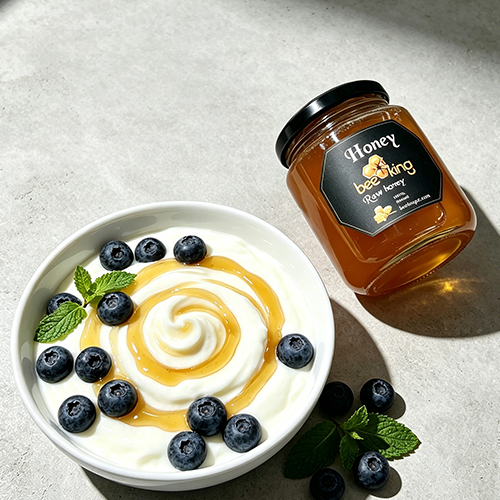
Cut to fit the curvature of the can body, making it more beautiful. Niche brands are highly recognizable and the cost of custom cutting is slightly higher.

Small Round Mark for Bottle Sealing
Used in conjunction with the main label on the can, it is used to mark batches, prevent counterfeiting and trace sources, and help strengthen brand unity.
What Must Be Included on a Legal Honey Bottle Labels Design?
Common Product Name
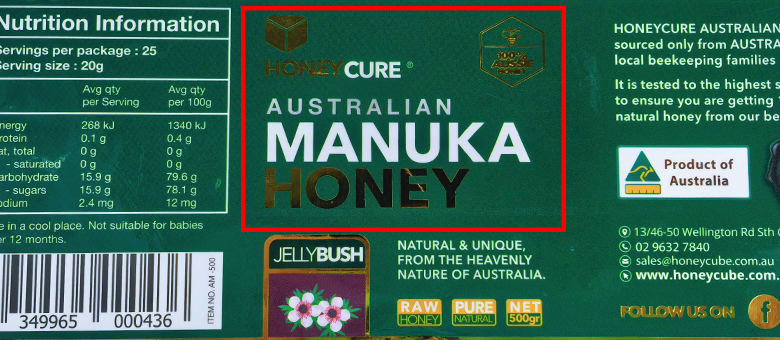
The product name must accurately describe the honey and should not mislead consumers. Avoid exaggerated claims such as “health honey.” For pure or single-flower honey, the product name should be clearly displayed on the label.
Net Content
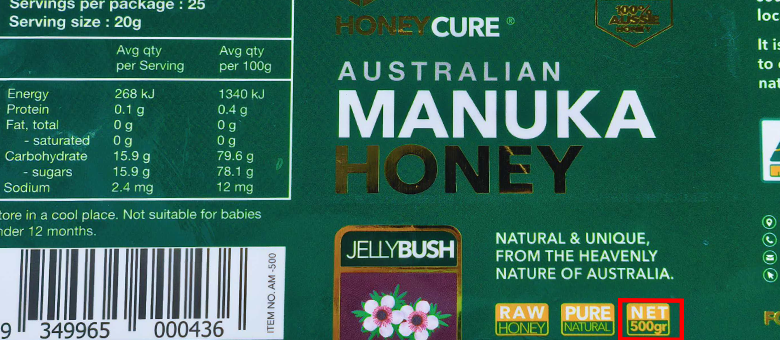
Net content must follow local measurement requirements. For the US and EU markets, labels commonly include both weight and volume units such as g and fl oz. The information should be placed in a clear and visible area of the label.
Manufacturer/OEM Client Information
Including company registered name, entity business address, official contact number, private farm OEM needs to supplement the farm registration number.
Nutrition Information
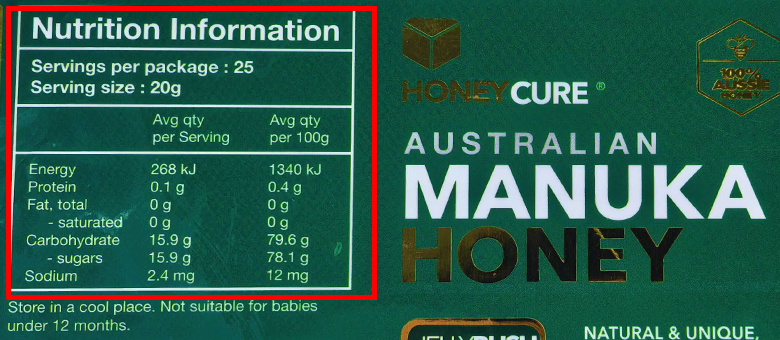
All ingredients must be accurately listed on the honey label in order of weight. Pure honey can be labeled as “honey,” while blended honey products must clearly identify all added ingredients.
Shelf Life and Best Consumption Period
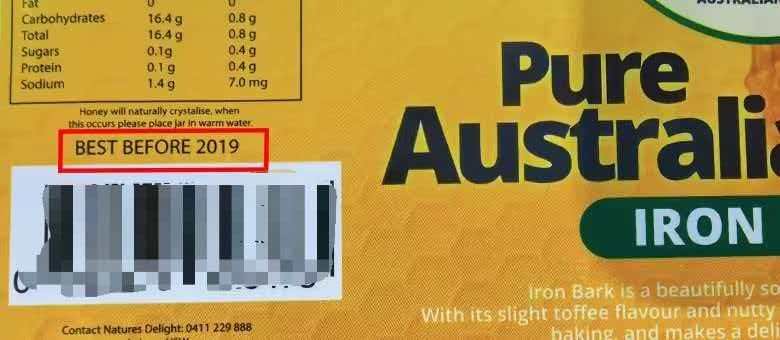
Honey has the characteristics of naturally low moisture, high sugar content and strong stability.
It is a long-lasting food. When sealed and properly stored, it is unlikely to cause immediate food safety risks due to the passage of time.Although not required by law, many companies still include a shelf life or best-by date on their products.
Honey Labeling Regulations Comparison
A comprehensive reference overview for key international markets (US, EU, and Australia).
| Region | Can I just label it “Honey”? | Origin requirements | Ingredient requirements | Special regulations |
|---|---|---|---|---|
| United States | Only pure honey can be labeled “Honey”. | Generally comply with origin labeling requirements (applicable to imported products). | If it contains other ingredients, all ingredients must be listed. | Added syrup, etc. cannot only be labeled “Honey”.
[U.S. Food and Drug Administration] |
| European Union | Must meet the definition of honey to be labeled “Honey”. | The country of harvest must be labeled; There are special rules for mixed honey, and in recent years regulations have further strengthened source labeling. |
Honey must not be sold as “Honey” after adding other food ingredients. |
Starting from 2026, the source labeling requirements for mixed honey will be further strengthened.
[EUR-Lex]
|
| Australia | Must be real honey to be called “Honey”. | General food labeling rules apply and the source may be indicated. | When other ingredients are added, the ingredients should be named and listed according to the actual nature of the product. | Food standards are generally followed and misleading consumers into mistaking mixed products for pure honey is not allowed. |
Additional Label Requirements
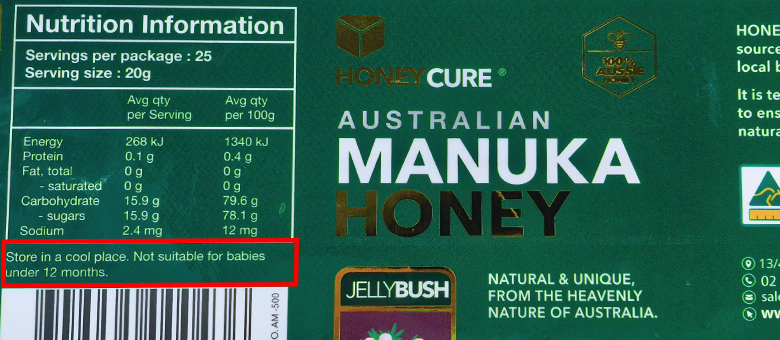
Honey labels should include required traceability information and warnings according to different market regulations. Avoid unverified health or medical claims, as they may cause compliance issues and affect product sales.
FAQ
What is the best material for honey bottle labels?
Are honey labels waterproof?
Can I order custom honey labels in small quantities?
What printing method is used for honey jar labels?
Can honey labels include foil stamping or embossing?
What label shapes and sizes work best for honey jars and squeeze bottles?

Need Help Customizing Your Own Packaging Design?
Whether you need Cosmetic Labels, Wine Labels, Food Labels, or Custom Adhesive Stickers, our experts can recommend the best material based on your product, application, and budget.