
The Complete Guide to Anti-Counterfeiting Labels
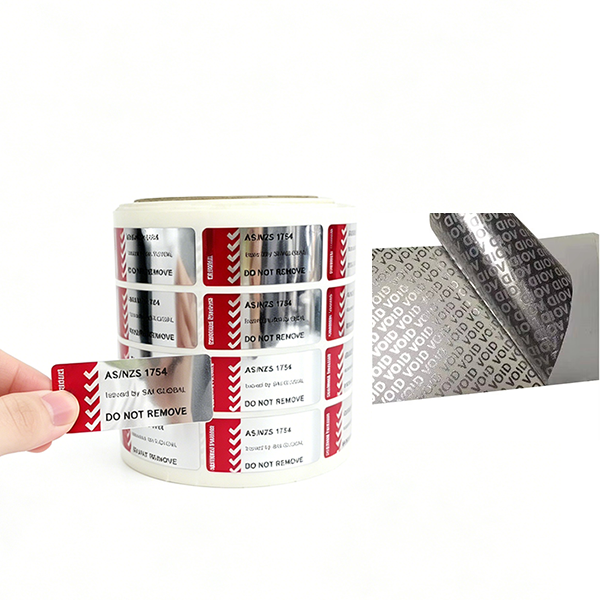
Counterfeiters peddling knock-offs under your brand,that’s a headache I’m sure you’ve felt. Deceived consumers paid full price for counterfeit goods.Especially, in stuff like pharmaceuticals or food, it’s not just about money; it can actually be dangerous.
Trust? That erodes quietly over time. Like each fake product chips away at your reputation.Well, anti-counterfeiting labels which use technical hurdles that raise the bar on copying.
It’s not just a sticker, it’s a barrier that making imitation so costly and complex that counterfeiters often just don’t bother.
Circulation of fakes gets curbed. More importantly, consumers can quickly verify the authenticity of the product using the anti-counterfeiting label.
From my perspective, is huge for their confidence. They can buy your products without that nagging doubt.That kind of protection doesn’t just shield your intellectual property and market share.
Anti-counterfeiting labels further safeguard people’s health and safety, as well as their legitimate rights and interests.
Why are Anti-counterfeiting Labels So Crucial for Brands?
Counterfeit products primarily capture market share from legitimate goods by circulating at low prices. These counterfeit products will steal the market share that the brand originally held and divert customers.
Anti-counterfeiting labels can give each genuine product a unique identifier. So consumers and distributors can spot a fake instantly.
With ‘one item, one code’ data, brands can pinpoint counterfeit hotspots and launch targeted offline enforcement. This eliminates fake products at the source and protects long-term brand revenue.
Low-quality fakes that hang around for too long erode a brand’s reputation over time.Consumers can’t tell real from fake, and when something goes wrong,they point the finger straight at the real brand.
Anti-counterfeiting labels give people a way to check if a product’s genuine, which should cut through the confusion.
And when counterfeit complaints do pop up, brands can rely on their tracking data to clear things up, assign responsibility, and draw clear lines.That helps stop negative chatter from sticking to the brand image so hard.
Governments worldwide strictly regulate high-risk industries like pharma and food, blocking non-compliant products from entering the market. For instance, the US DSCSA mandates serialization for all pharmaceuticals.
When taking legal action against fake products, intact labels and tracking data serve as core evidence. A three-tiered security setup creates a seamless chain of evidence, drastically easing the burden of proof and boosting your chances of winning lawsuits.
The 3 Levels of Anti-counterfeiting Labels
| Security Tier | Verification Method | Target Audience | Core Technologies | Commercial Value & Focus |
|---|---|---|---|---|
|
Level 1 Overt Security |
Visual inspection (No tools required) | End consumers, retail staff, general public |
|
Builds immediate brand trust; provides intuitive physical tamper-evidence and primary screening. |
|
Level 2 Covert & Digital Security |
Requires basic tools (Smartphones, UV light, decoder lenses) | Distributors, supply chain auditors, security-conscious buyers |
|
Enables end-to-end supply chain traceability, anti-gray market monitoring, digital marketing, and advanced authentication. |
|
Level 3 Forensic Security |
Requires specialized laboratory equipment or chemical reagents | Brand legal teams, judicial appraisers, anti-counterfeiting authorities |
|
Provides indisputable, court-admissible evidence for legal litigation; virtually impossible to copy or reverse-engineer. |
Introduction to Mainstream Anti-counterfeiting Technologies
Anti-counterfeiting Materials:
Fragile paper: The tensile strength of the face material is far lower than the adhesive’s bonding strength. If forcibly removed after application, the label shatters, preventing malicious reuse or tampering. It is cost-effective and suitable for sealing cosmetics, food products, and small electronics.
VOID tamper-evident label:
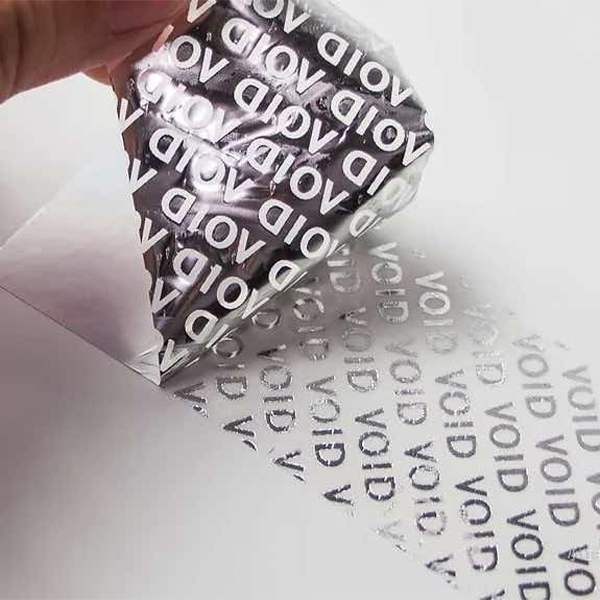
VOID tamper-evident labels fall into two categories: total transfer and partial transfer.
“Total transfer” means that when the label is peeled off the substrate, the word “VOID” remains on the product surface as a cutout pattern. The removed label loses both its original design and its adhesiveness.
Total transfer: Commonly used for sealing cartons and outer packaging. The primary purpose is to detect if the package has been opened in transit; any visible alteration to the label indicates that the package has been tampered with.
“Partial transfer” differs in that, upon removal, the word “VOID” remains on the label’s face material, leaving only faint traces on the substrate surface.
Partial transfer): More commonly used on device casings and high-value items. Since the “VOID” pattern remains directly on the product, evidence of tampering persists even if the label is completely destroyed and discarded; this makes the anti-counterfeiting and tamper-evident effects more obvious and harder to forge.
Anti-counterfeiting Process:
UV Printing Technology
UV printing relies on ultraviolet light to cure the ink, enabling the printing of invisible graphics and fluorescent hidden codes. These remain invisible to the naked eye under normal conditions but appear clearly when exposed to UV light. Often combined with overt labels as a dedicated verification point for channel auditing, the printed layer is thin and does not compromise the label’s appearance, making it suitable for a wide range of mid-to-high-end products.
Special Color-Changing Ink Technology
This involves two types of specialized inks:light-sensitive and temperature-sensitive. Once printed, the patterns display different colors depending on the angle of light or temperature changes, creating a distinct visual effect .
The formulation and manufacturing process of this ink are extremely complex, involving high technical barriers that make counterfeiting difficult.
It is frequently used for primary identification on high-end spirits, official documents, and luxury goods packaging to enhance intuitive authentication capabilities.
Holographic Technology
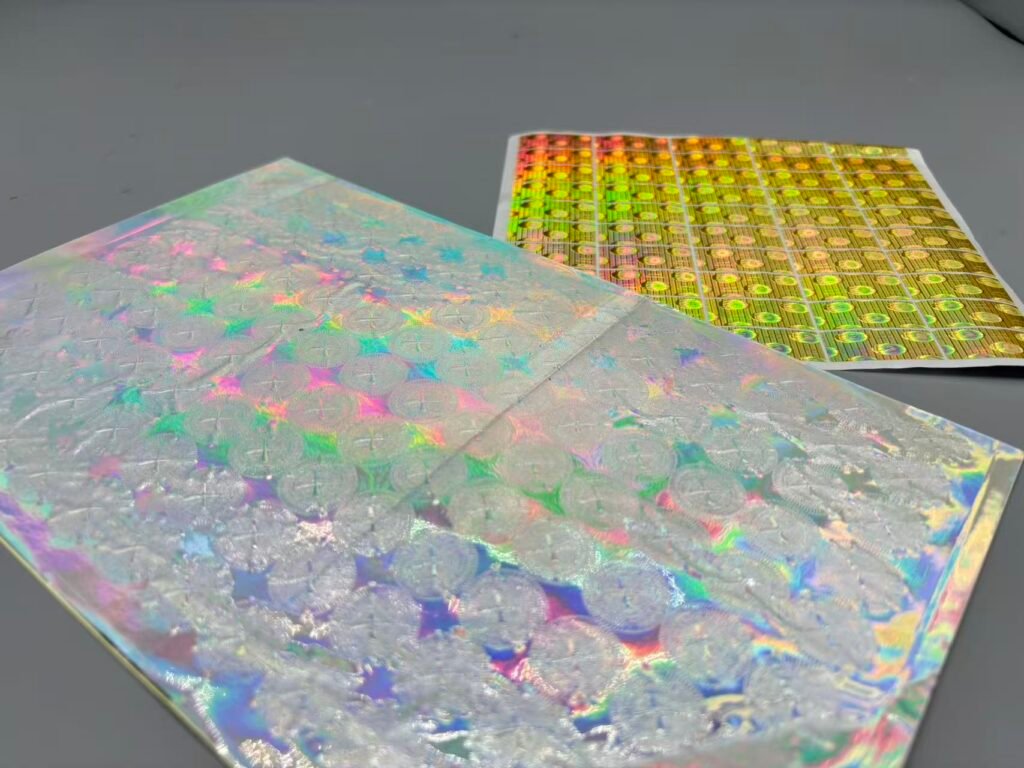
Using grating-based plate making, this process creates 3D, dynamic, shimmering laser patterns that incorporate multi-layered hidden graphics and micro-lines. The high cost of the necessary plate-making equipment makes it difficult for small-scale counterfeiters to replicate. It can be applied as a full-label sticker or via partial hot stamping and is the most widely used overt anti-counterfeiting technology on the market.
Irregular Die-Cutting (Patterned Cut) Technology
Irregular die-cut patterns are applied to the label edges or printed areas. If the label is subjected to force, it breaks along the pre-cut lines, making it impossible to remove or transfer intact. Often paired with fragile paper or “VOID” tamper-evident film to reinforce tamper resistance, this technology is commonly used for security seals and closure labels.
“One Item, One Code” QR Coding Technology
Each unique QR code for each product, incorporating anti-copying micro-patterns that prevent verification via screenshots or photocopies.
Admin panel capture real-time data on scanning location, time, and device details. Combining anti-counterfeiting, anti-diversion, and marketing interaction capabilities.
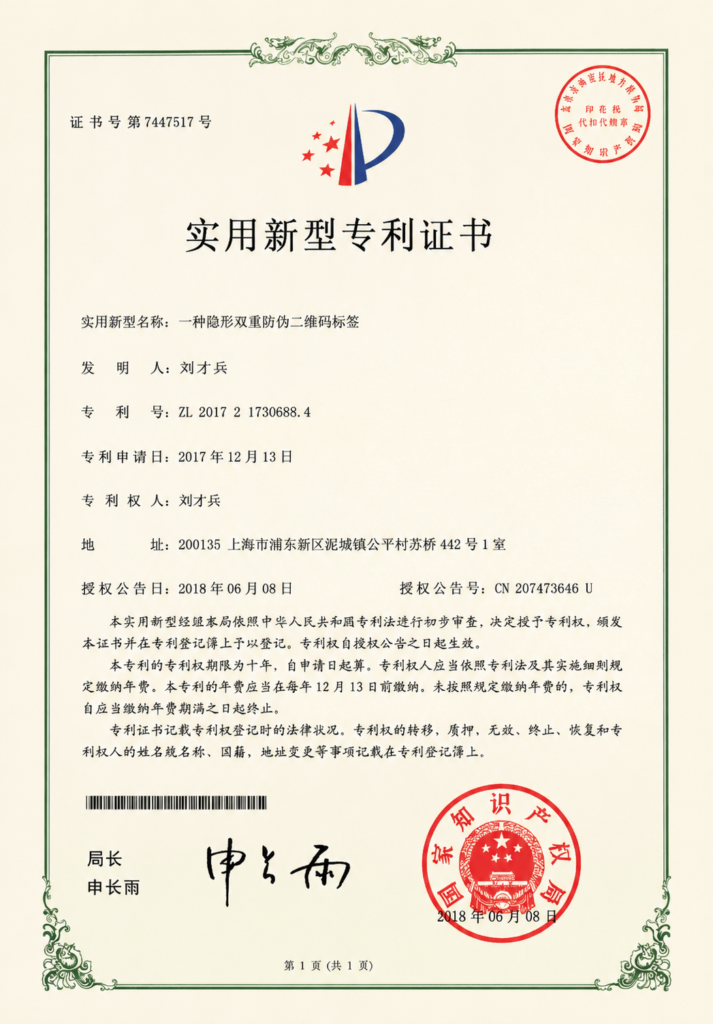
Printpacking also has an associated verification mechanism of light and dark dual codes, which effectively solves the problem of traditional single-layer QR codes being easily copied and transferred.
In addition to a publicly visible QR code printed on the surface, it can be used for product traceability, brand display or marketing activities. The bottom layer is also printed with a hidden QR code, which adheres firmly to the product.
Only by verifying the one-to-one correlation between the “clear code” and the “secret code” and matching the two, can it be determined to be genuine.
Industry Application Scenarios
Pharmaceuticals & Healthcare
- Fragile Paper / VOID Seals: Destroys packaging upon opening, preventing illicit reuse[cite: 1].
- “One Item, One Code” Dual-Code: Tracks serials to eliminate supply chain channel diversion[cite: 1].
High-End Spirits & Beverages
- Color-Changing Ink & Holograms: Enables rapid visual verification via light or temperature shifts[cite: 1].
- Irregular Pattern Die-Cutting: Label shatters upon bottle opening, preventing intact label transfer[cite: 1].
Luxury Goods & Cosmetics
- UV Fluorescent Invisible Ink: Discrete verification for auditors without ruining premium aesthetics[cite: 1].
- Partial Transfer VOID Film: Leaves persistent residue directly on high-value device packaging[cite: 1].
Automotive & Industrial Equipment
- Heavy-Duty VOID & Micro-Text: Resists harsh environments while preventing optical forgery[cite: 1].
- Backend Scan Intelligence: Captures real-time location data to pinpoint fake distribution hotspots[cite: 1].
FAQ
How do I choose the right security label for my product?
Match the label to your security needs: use Overt Holograms for instant retail trust, VOID seals for physical tamper-evidence, and Encrypted QR/NFC chips for high-value supply chain traceability.
What is the main difference between VOID and destructible paper labels?
VOID labels leave a hidden “VOID” message on the surface when peeled, while destructible paper labels shatter into tiny fragments, making transfer or reuse impossible for both.
How do dynamic QR codes stop counterfeiters from copying labels?
Each product gets a unique “One-Item-One-Code” identity. Once scanned, the cloud backend records it; if cloned codes appear elsewhere, the system flags them instantly as invalid.
Are your anti-counterfeiting labels compliant with international standards?
Yes. Our labels comply with FDA, REACH, and RoHS standards for safe packaging, and support DSCSA serialization for pharmaceutical and regulated industries.
What is the MOQ and turnaround time for custom security labels?
Custom MOQs start at 1,000 to 5,000 pieces depending on technology, with a standard production lead time of 7 to 12 business days after proof approval.
Will these security labels stick to rough, oily, or curved surfaces?
Yes. We use specialized high-tack acrylic adhesives designed specifically to bond permanently to low-surface-energy plastics, textured boxes, or greasy metal components without peeling.

Need Help Customizing Your Own Packaging Design?
Whether you need Cosmetic Labels, Wine Labels, Food Labels, or Custom Adhesive Stickers, our experts can recommend the best material based on your product, application, and budget.