
A Complete Guide to Transparent Barcode Labels: The Perfect Blend of Aesthetics and Scannability
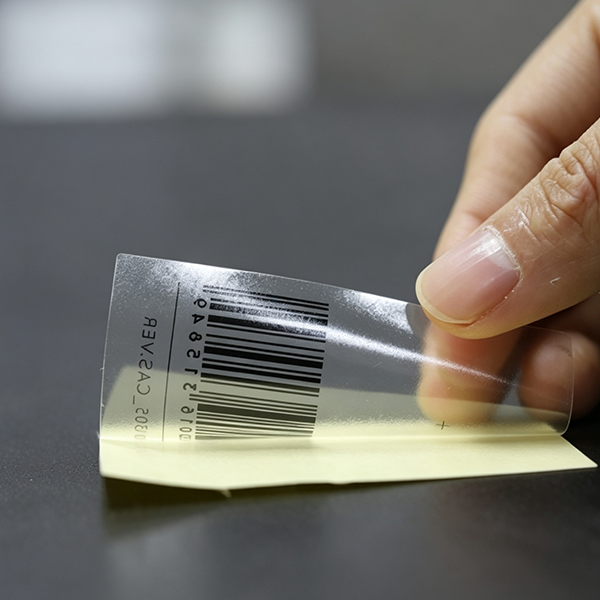
Transparent barcode labels are self-adhesive labels made from transparent materials such as PET, PVC, and BOPP. Unlike traditional barcode labels, they are transparent and appear “invisible” after being applied, thus revealing the product’s inherent appearance.
Why Choose Transparent Barcode Labels?
Without Affecting Product Aesthetics
Traditional white barcode labels offer good black-and-white contrast and typically ensure stable scanning. However, when affixed to transparent containers, the prominent white background can disrupt the overall packaging design. Transparent barcode labels create a “no-label look” that preserves the product’s original color and allows the label to blend seamlessly into the packaging with barely visible borders. This allows the barcode to blend seamlessly with the product packaging while maintaining high scanning reliability.
White Underprint Ensures High Scannability
While the “no-label look” is more aesthetically pleasing and minimalist, it also presents some unavoidable problems. When transparent labels are affixed to dark liquid bottles, colored packaging, or metal surfaces, the contrast between the black barcode and the background can be significantly reduced, making scanning very difficult.
To address this issue, transparent labels typically employ a white ink underprint technique.By precisely printing a layer of white ink beneath the black barcode area, a stable light-colored background is created, upon which the black barcode is then printed. Besides white ink underprinting, it is suitable for various printing processes. For example, when affixing to glass bottles, it can be used for reverse offset printing (adhesive-backed printing) and stencil printing, achieving transparent text while preserving the product’s original color.
Durability and Weather Resistance
Transparent barcode labels typically use a film as the face material, offering better durability compared to ordinary paper labels. Severe wear, blurring, or contamination of the barcode surface can affect the recognition by scanning equipment. Therefore, in addition to the print quality of the barcode itself, the face material and surface protection process are equally important. By selecting a suitable synthetic film and adding matte, glossy, or other protective layers depending on the usage environment, the label’s abrasion resistance, water resistance, and long-term stability can be further improved.
Material Selection for Transparent Barcode Labels
| Material | Clarity | Stiffness | Temp Resistance | Applications |
|---|---|---|---|---|
| Clear PET (Polyethylene Terephthalate) | Ultra-High (Transmittance ≥90%) | High | -40°C to 150°C | High-end Cosmetics, Electronics, Outdoor Labels |
| Clear BOPP (Biaxially Oriented PP) | High (Transmittance ≥85%) | Medium-High | -20°C to 80°C | Food & Beverage, Personal Care, General Retail |
| Clear PP (Polypropylene) | Medium-High | Medium | -10°C to 70°C | Cost-Sensitive Applications, Short-Term Labels |
| Clear PVC (Polyvinyl Chloride) | High | Medium | -20°C to 60°C | Conformable Curved Surfaces (Rarely for Barcodes) |
The Secret to Easy Scanning of Transparent Barcode Labels
Contrast Ratio
The vast majority of 1D barcode scanners (whether laser or imaging) operate on the following logic: emit light → receive reflected light → identify the pattern → decode into digital information.
Scanners read barcodes by differences in reflectivity, quantified in the industry using the PCS (Print Contrast Signal) value:
PCS = (Reflectivity of blank areas – Reflectivity of bars) / Reflectivity of blank areas
For most general scanning scenarios, a PCS value of 0.5 or higher is required for stable scanning; in industrial or automated warehousing scenarios, the requirement is typically higher (above 0.7).
When printing black barcodes directly on a transparent substrate, the problem lies in the “blank” areas. Transparent areas lack a reflective layer; light penetrating the label is absorbed by the container or irregularly reflected, resulting in extremely low reflectivity in the “blank” areas. The PCS value between bars and blanks may drop below 0.2, making it impossible for the scanner to distinguish them.This is why transparent barcode labels must have a white backing layer printed underneath the barcode area.
| Parameter / Standard | Standard Paper Label | Clear Label (Direct Print) | Clear Label (With White Underprint) |
|---|---|---|---|
| PCS Value (Print Contrast Signal) | ≥ 0.7 (High) | < 0.2 (Unscannable) | ≥ 0.5 – 0.7 (Industry Grade) |
| White Ink Optical Density (OD) | N/A | None | ≥ 1.5 (2-3 Overprint Layers) |
| Visual Appearance | Standard White Block | Fully Transparent | Seamless “No-Label Look” |
Black Barcode with A White Ink Underprint
The white ink layer is not exactly the same size as the barcode; it typically extends 1-2mm outwards around the barcode. This compensates for printing registration errors, ensuring the white ink doesn’t show through the barcode edges due to slight misalignment. It also provides a continuous reflective background for the barcode, preventing insufficient contrast in edge areas.
The white ink layer must have sufficient opacity (usually requiring an OD value ≥ 1.5) to completely block interference from the container’s background color. If the white ink is too thin, the color of the dark container will show through, reducing overall contrast.
In actual production, 2-3 layers of white ink overprinting are usually required to achieve the ideal opacity. This is one reason why transparent barcode labels are more expensive than ordinary labels.
During printing, the black ink also needs to ensure sufficient density (OD value ≥ 1.0) and sharp edges. Bar Width Reduction (BWR) needs precise control because the overprinting of white and black ink can cause a slight increase in bar width, which needs to be compensated for in advance during plate making.
The area outside the barcode remains completely transparent, without any background color printed. This means that the rest of the label (such as the brand name and product information) can use other designs. From the front, the white ink is covered by the black code, making it almost imperceptible to the naked eye.
FAQ

Need Help Customizing Your Own Packaging Design?
Whether you need Cosmetic Labels, Wine Labels, Food Labels, or Custom Adhesive Stickers, our experts can recommend the best material based on your product, application, and budget.