
Stickers vs Labels: A Ultimate Guide for Packaging
Most people think that all stickable paper can be called “stickers”, and labels are just another name for stickers.In fact, there are essential differences between stickers and labels:
Stickers focus on decorative properties and are cultural and creative products and daily consumer goods;Labels focus on information carrying and functional attributes, and are packaging accessories and industrial accessories.
There are significant differences between the two in terms of design logic, production standards, purpose of use, and durability.
Today we’ll briefly analyze the core concepts and differences between stickers and labels.
What Are Stickers?
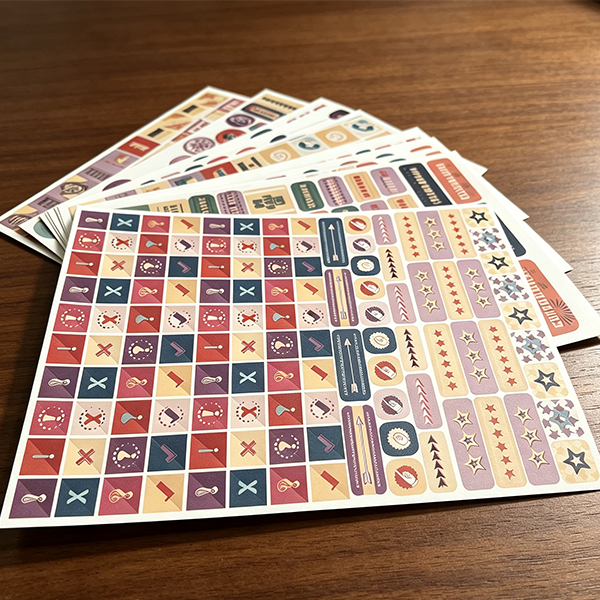
A sticker is a paper or film material with an adhesive on it.Various patterns or cartoon images are printed on the surface material, which is very popular among children and teenagers.
As a popular daily cultural and creative product, it does not have strict industry standards and mandatory information requirements.
Different from labels, it hardly undertakes functions such as information description, traceability, identification, and standard annotation.
Its main function is to embellish items, beautify the appearance, and express personality.Such as notebook stickers, mobile phone stickers, luggage stickers, etc., are only for visual decoration.
The stickers have rich patterns, bright colors, and changeable shapes, and can be made into various creative styles such as special shapes, gradients, and lasers.
It has a high degree of freedom, no fixed format requirements, and completely follows aesthetic and trend design.As a daily decoration, we can add stickers to our daily items to give them a personal touch.
Compared with commercial labels, everyday decorative stickers usually have simpler production requirements and lower durability standards.
Unlike labels, which have strict requirements on glue viscosity, abrasion resistance, temperature resistance, and waterproofness.
For short-term use in daily life, it can be replaced at will without having to consider its appropriate use environment.If it’s broken, just replace it with a new one and stick it on again.
Do you often see these two words when searching for stickers: die cut and kiss cut.
These are actually two very common types for stickers.
- Die cut slices through both sticker and liner to separate each piece completely.
- Kiss cut only cuts the sticker surface while keeping the liner intact, so stickers stay connected for easy storage.
Stickers are mainly decorations to personalize daily items.
What Are Labels?
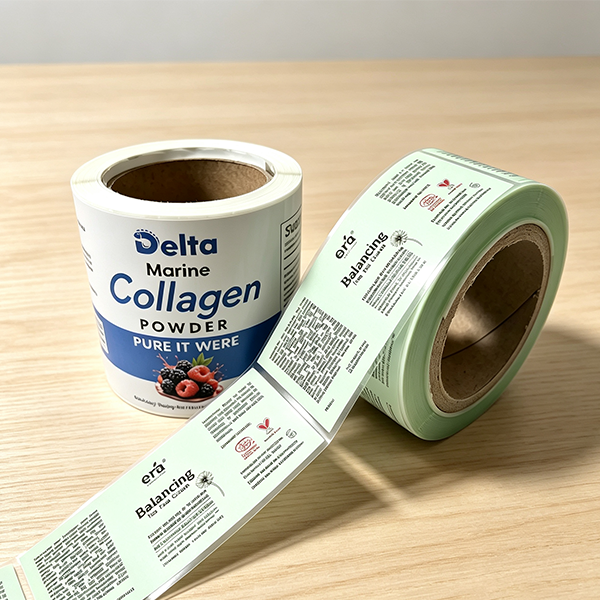
The composition of labels is roughly the same as stickers, consisting of surface material, adhesive and backing paper.But its main function is to carry information, standardize labels, traceability instructions, and display quality.
Common product description stickers, anti-counterfeiting labels, size labels, logistics labels, and ingredient labels all fall into the category of labels.
Key Features of Labels
1. Practical First Decoration Second
The core value of labels is to mark valid information, including product name, ingredients, production date, shelf life, specifications, anti-counterfeiting codes, barcodes, QR codes, manufacturers and other standardized information.
Some high-end labels will be equipped with hot stamping, embossing and other processes to enhance the texture, but decoration is only an additional attribute.
2. Strict Standards
For regulated industries such as food, cosmetics, chemicals, and electronics, labels must comply with specific industry standards regarding required information, readability, durability, and placement.
Therefore, commercial and industrial labels must strictly abide by industry regulations and national labeling standards.Information layout, font size, content elements, and material performance all have clear requirements and cannot be designed at will.
It is necessary to guarantee compliant, traceable and verifiable product information to protect consumer rights and stabilize the market.
3.Strong Durability
Labels have extremely strict standards for production technology, glue quality, and substrate performance.
Problems such as easy breakage, falling off, fading, etc. are not allowed.Therefore, it needs to be considered that it has to deal with complex environments such as moisture, high temperature, friction, and exposure.
It needs to have multiple stable properties such as waterproof, oil-proof, friction resistance, high and low temperature resistance, and anti-falling resistance.
Stickers vs Labels: What’s the Difference?
| Comparison | Stickers | Labels |
|---|---|---|
| Main Purpose | Decoration & personalization | Product identification & information |
| Primary Function | Visual appeal | Information communication |
| Common Uses | Laptop, notebook, phone, gifts | Food packaging, bottles, industrial products |
| Design Freedom | High | Limited by regulations |
| Durability | Short-term | Long-term performance required |
| Compliance | Usually no requirements | Must follow industry standards |
| Materials | Paper, vinyl, PET | BOPP, PET, thermal paper, vinyl |
| Printing | Creative printing | Precision & functional printing |
Stickers vs Labels : Difference in Materials
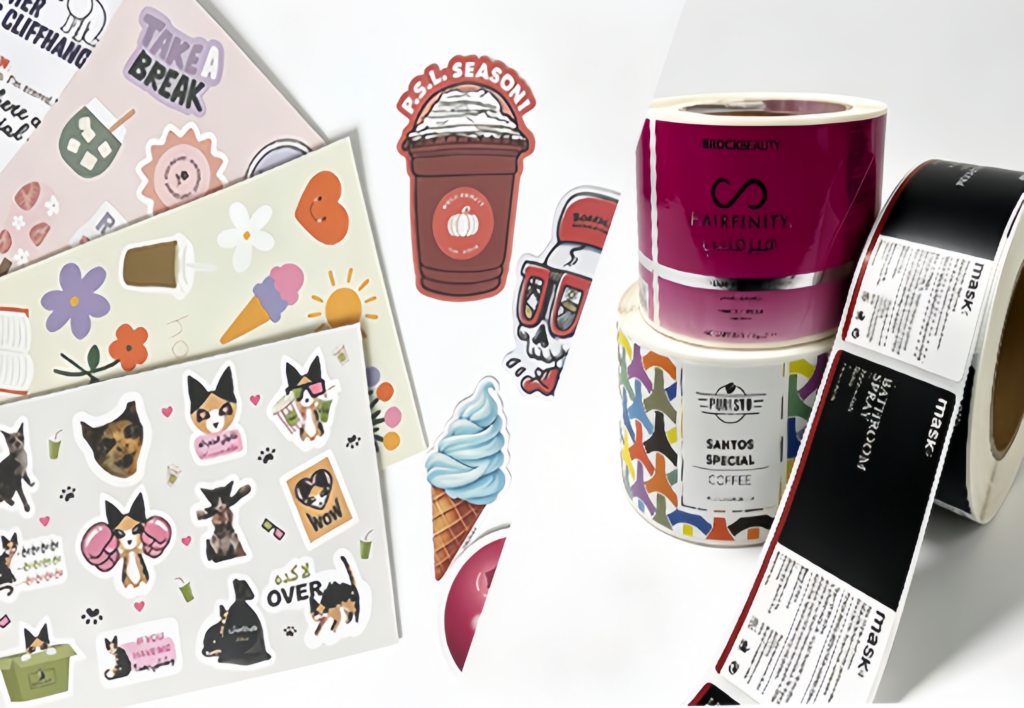
The most common materials used for daily stickers are coated paper and vinyl. They almost cover most of the sticker needs in our lives.
Coated Paper
Sticker MaterialCoated paper has a smooth and delicate surface, high whiteness, strong printing adaptability, high color reproduction and good gloss. Just in line with stickers’ emphasis on color expression and visual effects.
Made into various decorative stickers or name stickers, which can be used as decoration on notebooks, computer cases and other daily necessities. (If you prefer a natural texture, custom kraft paper stickers are another popular paper option.)
Vinyl
Sticker MaterialVinyl surface can easily accept ink and can present clear and vivid image quality. It is also waterproof, moisture-proof, tear-resistant and wear-resistant.
Thanks to its resistance, the stickers can be placed on water bottles, suitcases, cars, bathrooms, etc.
The purpose of labels is different from stickers, and the information carried on them is more important. Printing clarity and long-term durability are more important for labels. Synthetic paper, PET and film materials are some common materials.
Synthetic Paper
Label MaterialSynthetic paper has a softer texture than PET but is still very strong and tear-resistant. Not only is it waterproof and oil-proof, but it can stick to surfaces for long periods of time without peeling off. It’s usually a high white matte or semi-matte appearance that’s classy, like a high-quality paper stock, but is actually a plastic film.
From my perspective, it’s perfect for situations where you need durability but still want a nice print on paper. It is very suitable for affixing to custom cosmetic labels, weather-affected outdoor labels, damp frozen food labels, and even clothing hang tags.
PET
Label MaterialThe texture is hard and brittle, the tensile strength is extremely high, and it is very tear-resistant. It has excellent temperature resistance (usually withstands high temperatures from -40°C to 150°C), and is resistant to acid and alkali and chemical corrosion.
Because it is extremely durable, it is often used in electronic appliances (such as mobile phone batteries, computer nameplates), automotive labels, chemical barrel labels, and asset labels that need to be preserved for a long time.
In addition to PET and synthetic paper, the film label category also includes several other important materials that together make up the broader range of film-based self-adhesive labels.
Whether you need bulk stickers on rolls for high-speed application or custom decorative decals, understanding material requirements ensures your packaging performs flawlessly.
FAQ

Need Help Customizing Your Own Packaging Design?
Whether you need Cosmetic Labels, Wine Labels, Food Labels, or Custom Adhesive Stickers, our experts can recommend the best material based on your product, application, and budget.